
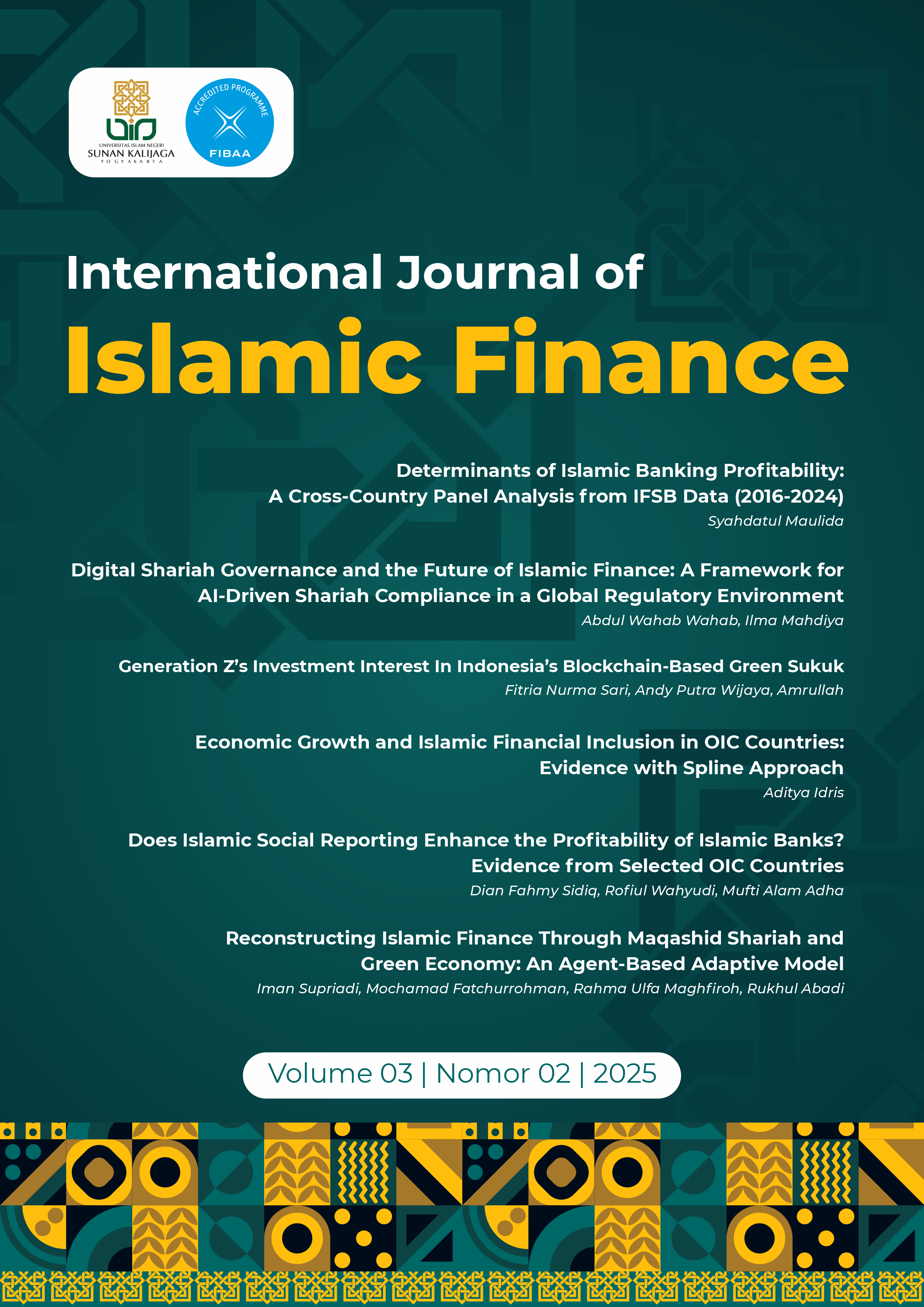
Digital Shariah Governance and the Future of Islamic Finance: A Framework for AI-Driven Shariah Compliance in a Global Regulatory Environment
DOI:
https://doi.org/10.14421/ijif.v3i2.2777Keywords:
Islamic Finance Governance, Artificial Intelligence (AI), Technology Acceptance Model (TAM), Institutional Theory, Maqasid al-ShariahAbstract
Background: Digital transformation in Islamic finance offers significant opportunities while simultaneously challenging the sustainability of Sharia principles, particularly in governance, transparency, and compliance. Although Artificial Intelligence (AI) enhances operational efficiency and decision-making accuracy, its application raises ethical and juridical concerns due to the gap between technological innovation and maqasid al-shariah values.
Objectives: This study aims to develop a conceptual model of AI-based digital Sharia governance by integrating the Technology Acceptance Model (TAM), Institutional Theory, and Maqasid al-Shariah to explain technology acceptance, institutional legitimacy, and the realization of public welfare objectives.
Novelty: The novelty lies in integrating these three major frameworks, which are rarely combined in Islamic finance studies, by bridging user acceptance, institutional pressures, and Islamic normative values within a unified digital Sharia governance model.
Research Methodology / Design: This study adopts a conceptual-theoretical approach through systematic analysis and synthesis of reputable international literature in Islamic finance, financial technology, and ethical governance. The model links perceived usefulness, institutional legitimacy, and maqasid orientation without employing empirical data.
Findings: The proposed model indicates that the success of AI-driven digital Sharia governance depends on the synergy between user acceptance, institutional compliance, and alignment with maqasid al-shariah values, particularly justice, public welfare, and the protection of collective interests.
Implication: Theoretically, this study contributes to the literature on the integration of technology and Islamic ethics. Practically, it provides a strategic reference for regulators and Islamic financial institutions in designing AI-based digital governance frameworks that are not only technologically efficient but also Sharia-compliant and ethically grounded.
References
Downloads
Published
Issue
Section
License
 All publication from International Journal of Islamic Finance are licensed under a Creative Commons Attribution-ShareAlike 4.0 International License