
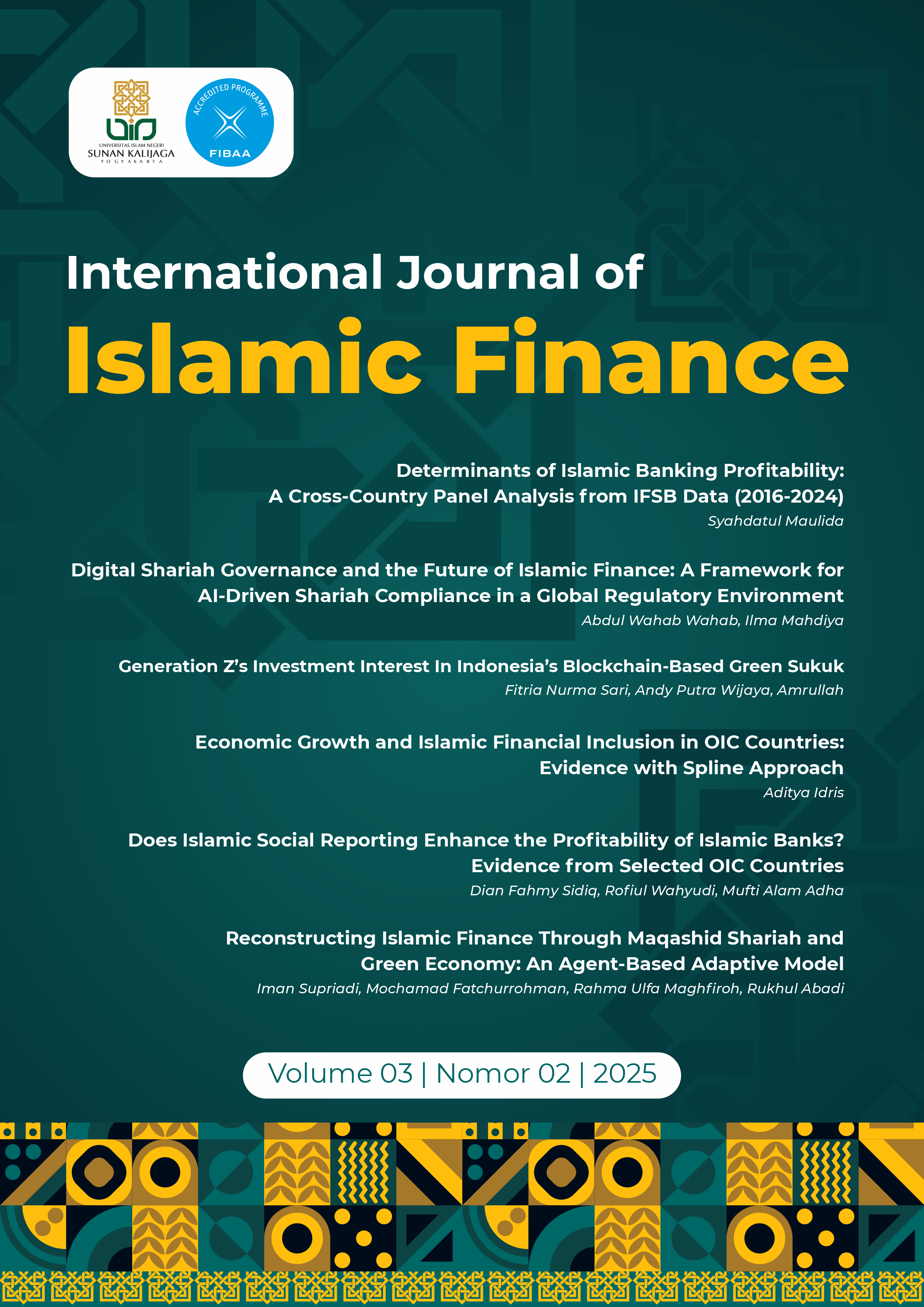
Reconstructing Islamic Finance Through Maqashid Shariah and Green Economy: An Agent-Based Adaptive Model
DOI:
https://doi.org/10.14421/ijif.v3i2.2801Keywords:
Islamic Finance, Green Economy, Carbon Tax, Green Subsidy, Agent-Based ModelingAbstract
Background: The global financial landscape is evolving toward greater ethical, social, and environmental accountability. However, Islamic finance originally a moral alternative to capitalism often mirrors conventional systems with limited Shariah depth. Bridging the gap between maqāṣid al-sharīʿah ideals and practice requires reconstructing Islamic financial governance through an integrative model aligning Shariah principles with green economy sustainability.
Objectives: This study aims to reconstruct an Islamic financial model grounded in maqashid al-shariah and green economy principles through the Agent-Based Modeling (ABM) approach, in order to understand how green fiscal policies such as carbon taxation and green subsidies affect the investment behavior of Islamic financial institutions and the dynamics of economic sustainability.
Novelty: This research introduces a novel conceptual framework called the Maqashid Green Adaptive Finance System (MGAFS), which operationalizes maqāṣid al-sharīʿah within the context of adaptive financial governance. Unlike prior studies that are predominantly descriptive or institutional, this study employs ABM to dynamically simulate multi-agent interactions among regulators, IFIs, and consumers in response to green fiscal policies. The model represents a methodological and theoretical innovation by bridging Islamic ethical foundations with computational systems thinking, thereby transforming maqāṣid al-sharīʿah from a normative doctrine into an empirical tool for sustainability analysis.
Research Methodology / Design: This study employs an experimental computational approach based on Agent-Based Modeling (ABM) involving three primary agent groups: regulators, Islamic financial institutions (IFI), and consumers. The main parameters include the number of consumers, number of IFI, simulation periods, carbon tax rates, and levels of green subsidies. Two policy scenarios high green subsidy and high carbon tax are compared to analyze the systemic responses to different policy interventions.
Findings: The simulation results indicate that green subsidies have a more significant impact on enhancing green investment and total income compared to carbon taxes. However, the combination of both policies produces a synergistic effect on the long-term stability of the Islamic financial system.
Implication: These findings provide an empirical foundation for policymakers to integrate the principles of maqashid shariah with green economic instruments, thereby strengthening sustainable and adaptive governance within the Islamic financial system amid the global ecological transition.
References
Downloads
Published
Issue
Section
License
 All publication from International Journal of Islamic Finance are licensed under a Creative Commons Attribution-ShareAlike 4.0 International License