 Open Access Journal
SOP of Manuscript Management
The manuscript management workflow of Sunan Kalijaga International Journal on Islamic Educational Research is designed to maintain a clear separation between administrative processing, peer review, editorial recommendation, and the final publication decision. The workflow is summarized in the figure below and further clarified through the responsibilities assigned to each editorial role.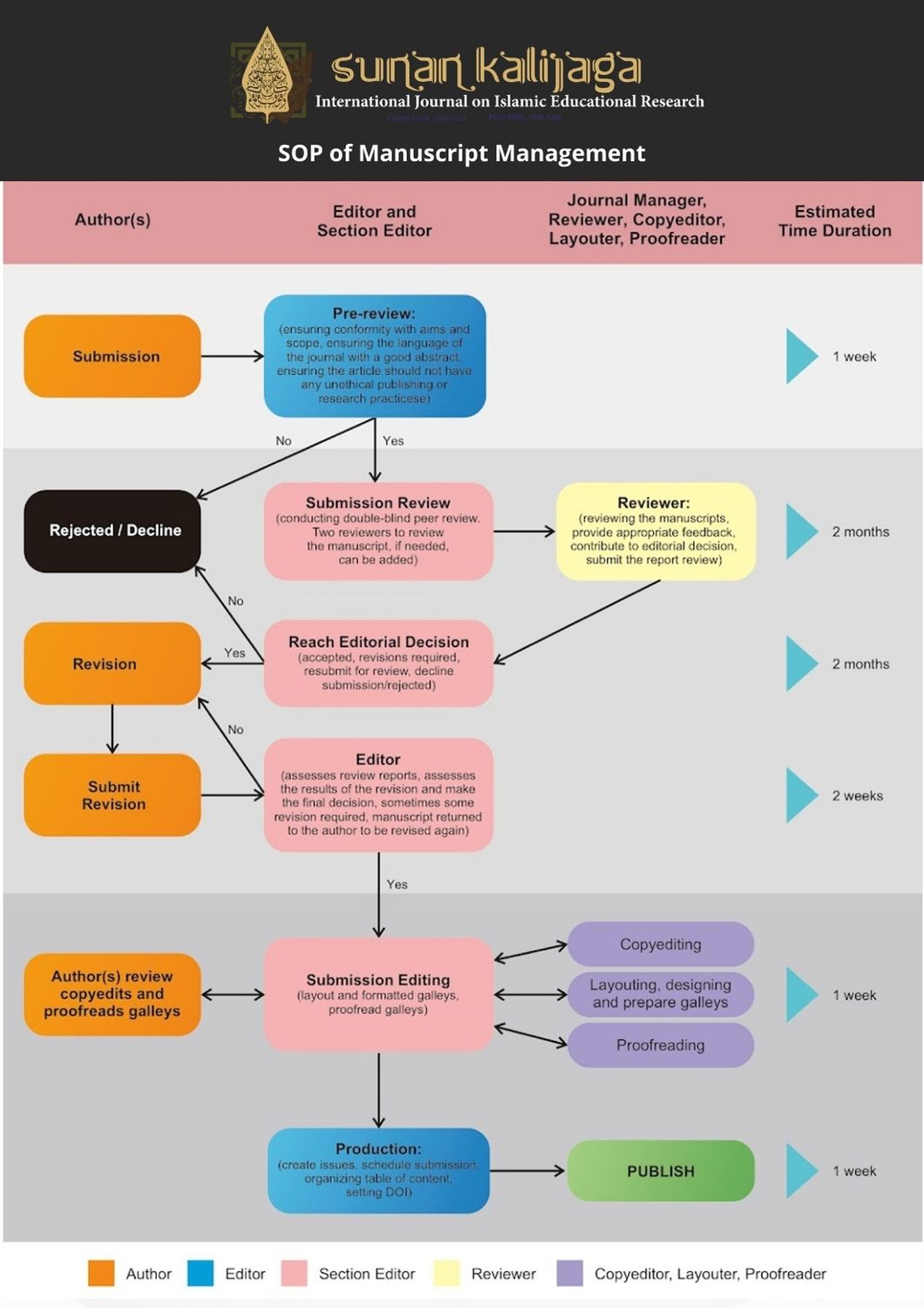
Manuscript submission and administrative screening: The author submits the manuscript and required documents through the journal's online submission system. The Managing Editor checks the completeness of the submission, metadata, required declarations, and technical compliance with the journal's guidelines.
Initial editorial screening: The Editor-in-Chief evaluates whether the manuscript is suitable for the journal's aims and scope and meets the journal's basic scholarly, originality, and ethical requirements. At this stage, the Editor-in-Chief may reject a manuscript without external review or assign it to an Editor who serves as the Handling Editor.
External peer review: The Handling Editor coordinates a double-anonymous peer review and invites at least two independent reviewers with appropriate expertise. Reviewers assess the manuscript and provide recommendations. Where necessary, an additional independent reviewer may be invited to resolve substantial differences between reports or to provide additional expertise.
Editorial recommendation: The Handling Editor evaluates the reviewers' reports and the author's response to revision requests, where applicable, and submits an editorial recommendation to the Editor-in-Chief. The Handling Editor does not make the journal's final publication decision.
Final editorial decision: The Editor-in-Chief has final authority to accept, request minor revision, request major revision, or reject a manuscript after considering the manuscript, reviewers' reports, revisions, and the Handling Editor's recommendation.
Production and publication: Manuscripts that receive final acceptance proceed to copyediting, proofreading, layout, metadata preparation, DOI registration, and publication. These production stages do not alter the scholarly decision already made by the Editor-in-Chief.