
About the Journal

Title : Journal of Islamic Economy and Community Engagement
Abbreviation : JIECEM
ISSN : 2809-5685 (Online)
DOI Prefix : 10.14421/jiecem
Ed. in Chief : Hasan Albanna
Assoc. Ed. : Egha Ezar JPH
Frequency : Biannual, June & December
Publisher : FEBI UIN Sunan Kalijaga
Citedness in : Google Scholar
    Garuda

Journal of Islamic Economy and Community Engagement is a scientific journal published by the Faculty of Economics and Islamic Business, UIN Sunan Kalijaga Yogyakarta, Indonesia. This journal is at an international level that covers many issues related to community-based research (CBR).

Focus and Scope

The Journal focuses on publishing community-based research and articles in community services and development in the fields of Islamic economics, business, management, and accounting related to community services and community development. The scope of this journal includes local Muslim communities, such as specific ethnic groups, cultural customs, or particular regions and religions on a global scale. Implementation of community service programs, as well as community participation, development and work with partners. Activities that are dedicated by the academicians and researchers to improve the community welfare.

Peer Review Process

The editor will firstly check every manuscript submitted. Those manuscripts evaluated by editors to be inappropriate to journal criteria are rejected promptly without external review. Manuscripts evaluated to be of potential interest to our readership are sent to double-blind reviewers. Every manuscript is independently reviewed by at least two reviewers in the form of a "double-blind review". The editors then make a decision for publication based on the reviewer's recommendation from among several possibilities: Accept, Accept with revisions, Submit for review, Submit elsewhere, or Decline.

In certain cases, the editor may submit an article for review to another, third reviewer before making a decision, if necessary. The Editor-in-Chief has the right to decide which manuscripts submitted to the journal should be published.

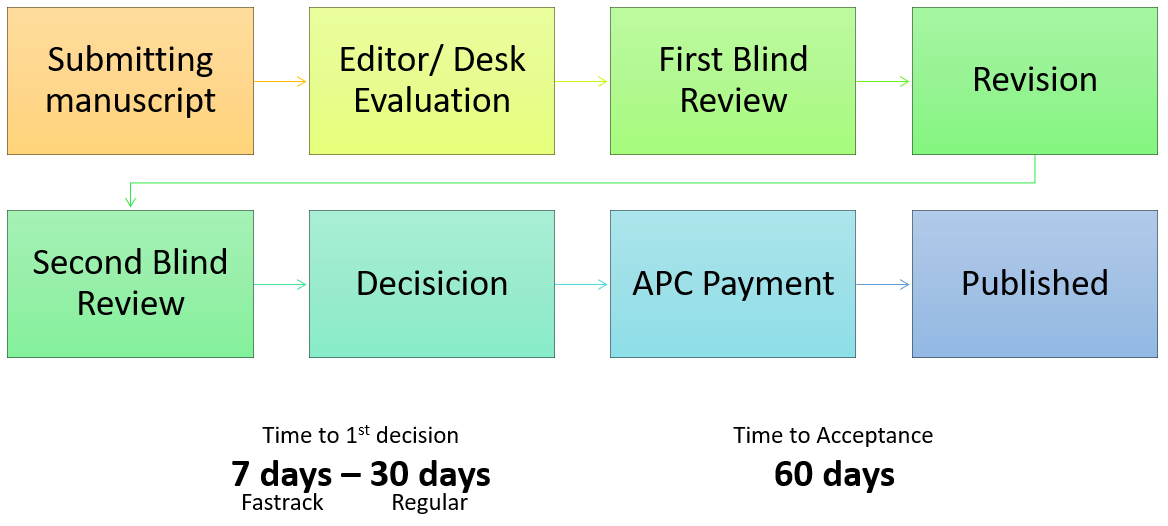
Review Process:

  1. Submitting Manuscript - The corresponding author submit the manuscript through an online journal system
  2. Editor/Desk Evaluation - Editor Board will identify the quality of the manuscript and the possibility of cases of scientific misconduct including authorship, ownership, and plagiarism. (some manuscripts are rejected or returned before the review process)
  3. Review Process - EkBis employs a double-blind manuscript review process. With a double‐blind review approach, the identity of both the author(s) and reviewer are unknown to both parties. After taking the role, reviewers need to give comments on the article and its decision.
  4. In case of revisions, the article is sent to the author(s) together with the reviewer's opinions. The authors are asked to respond to the comments and make the appropriate adjustments to the text. Then, the authors send back the corrected version.
  5. Editor decisionThe editor gives the final decision for the manuscript
  6. APC (Article Processing Charge) payment - authors complete the APC payment after the article is accepted. For further APC details, click Author Fees.

Publication Frequency

JIECEM is published biannually, every June and December. If it is necessary, a special issue will also be published.

Open Access Policy

This journal provides immediate open access to its content on the principle that making research freely available to the public supports a greater global exchange of knowledge.

Archiving

This journal utilises the LOCKSS system to create a distributed archiving system among participating libraries and permits those libraries to create permanent archives of the journal for purposes of preservation and restoration. More...

Article Publication Fee

Journal of Islamic Economy and Community Engagement does not charge APCs, submission charges, or any other fees. All processes of article publication are free of charge.

Plagiarism Policy

JIECEM will not tolerate any kind of plagiarism. Authors should clearly understand the publication ethics regarding plagiarism. To make sure that the manuscript is plagiarism-free, JIECEM will do at least two following steps:

  1. Rapid assessment by plagiarism-checking software (Turnitin/iThenticate) 
  2. Comprehensive assessment by editors.

Licensing

 This work is licensed under a Creative Commons Attribution-ShareAlike