Ejournal Home
 Search
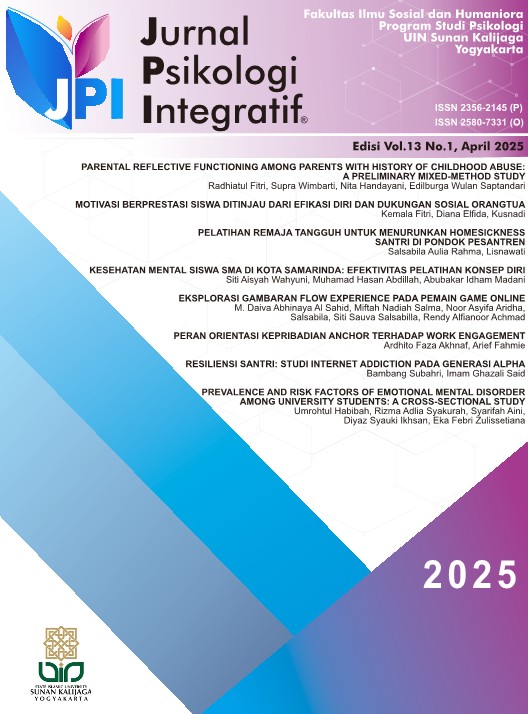
Parental Reflective Functioning Among Parents with History of Childhood Abuse: A Preliminary Mixed-Method Study
Main Article Content
 Radhiatul Fitri
Supra Wimbarti
Nita Handayani
Edilburga Wulan Septandari
Radhiatul Fitri
Supra Wimbarti
Nita Handayani
Edilburga Wulan Septandari
Abstract
This preliminary study explored Parental Reflective Functioning (PRF) among parents with a history of childhood abuse. PRF, the ability to understand a child’s mental state, played a key role in breaking the cycle of intergenerational maltreatment. An explanatory sequential mixed-method design was employed, involving 10 participants in a quantitative phase and two in a follow-up qualitative phase. No significant correlation was found between childhood abuse and PRF. However, qualitative findings revealed key themes, including coping strategies, parenting outcomes and related challenges. This study provided initial insights and highlighted the need for further research with larger samples.
Studi pendahuluan ini mengeksplorasi fungsi refleksi orangtua (FRO) pada orangtua dengan riwayat kekerasan di masa kanak-kanak. FRO, kemampuan untuk memahami keadaan mental anakk, berperan penting dalam memutus siklus kekerasan intergenerasi. Penelitian ini menggunakan desain mixed-method dengan pendekatan sekuensial eksplanatori, melibatkan 10 partisipan pada fase kuantitatif dan dua partisipan pada fase kualitatif lanjutan. Tidak ditemukan korelasi signifikan antara kekerasan di masa kanak-kanak dengan FRO. Namun, temuan kualitatif mengungkap tema-tema utama, termasuk strategi koping, outcome pengasuhan dan tantangan terkait. Studi ini memberikan wawasan awal dan menekankan perlunya penelitian lanjutan dengan jumlah partisipan yang lebih besar.
Downloads
Article Details
License

This work is licensed under a Creative Commons Attribution-NonCommercial-ShareAlike 4.0 International License.
Authors who publish with this journal agree to the following terms:- Authors retain copyright and grant the journal right of first publication with the work simultaneously licensed under a Creative Commons Attribution License that allows others to share the work with an acknowledgement of the work's authorship and initial publication in this journal.
- Authors are able to enter into separate, additional contractual arrangements for the non-exclusive distribution of the journal's published version of the work (e.g., post it to an institutional repository or publish it in a book), with an acknowledgement of its initial publication in this journal.
- Authors are permitted and encouraged to post their work online (e.g., in institutional repositories or on their website) prior to and during the submission process, as it can lead to productive exchanges, as well as earlier and greater citation of published work (See The Effect of Open Access).
References
Allen, J. G. (2018). Mentalizing In The Development And Treatment Of Attachment Trauma.
Bailey, H. N., Moran, G., & Pederson, D. R. (2007). Childhood maltreatment, complex trauma symptoms, and unresolved attachment in an at-risk sample of adolescent mothers. Attachment & Human Development, 9(2), 139–161.
Bateman, A. W., & Fonagy, P. (2019). Handbook of mentalizing in mental health practice. American Psychiatric Pub.
Berthelot, N., Lemieux, R., Garon-Bissonnette, J., Lacharité, C., & Muzik, M. (2019). The protective role of mentalizing: Reflective functioning as a mediator between child maltreatment, psychopathology and parental attitude in expecting parents. Child Abuse and Neglect, 95. https://doi.org/10.1016/j.chiabu.2019.104065
Blatt, S. J. (2008). Polarities of experience: Relatedness and self-definition in personality development, psychopathology, and the therapeutic process. American Psychological Association.
Borelli, J. L., Ensink, K., Gillespie, M. L., Falasiri, E., Bernazzani, O., Fonagy, P., & Berthelot, N. (2021). Mothers’ Self-focused Reflective Functioning Interacts with Childhood Experiences of Rejection to Predict Current Romantic Relationship Quality and Parenting Behavior. Family Process, 60(3), 920–934. https://doi.org/10.1111/famp.12603
Condon, E. M., Dettmer, A., Baker, E., McFaul, C., & Stover, C. S. (2022). Early life adversity and males: Biology, behavior, and implications for fathers’ parenting. Neuroscience and Biobehavioral Reviews, 135. https://doi.org/10.1016/j.neubiorev.2022.104531
Connelly, L. M. (2016). Trustworthiness in qualitative research. Medsurg Nursing, 25(6), 435.
Corbin, J., & Strauss, A. (2015). Basics of Qualitative Research (Issue v. 14). SAGE Publications. https://books.google.co.id/books?id=Dc45DQAAQBAJ
De Roo, M., Wong, G., Rempel, G. R., & Fraser, S. N. (2019). Advancing Optimal Development in Children: Examining the Construct Validity of a Parent Reflective Functioning Questionnaire. JMIR Pediatrics and Parenting, 2(1), e11561. https://doi.org/10.2196/11561
Decarli, A., Schulz, A., Pierrehumbert, B., & Vögele, C. (2022). Mothers’ and Fathers’ Reflective Functioning and Its Association With Parenting Behaviors and Cortisol Reactivity During a Conflict Interaction With Their Adolescent Children. Emotion. https://doi.org/10.1037/emo0001113
Ensink, K., Berthelot, N., Bernazzani, O., Normandin, L., & Fonagy, P. (2014). Another step closer to measuring the ghosts in the nursery: Preliminary validation of the trauma reflective functioning scale. Frontiers in Psychology, 5(DEC), 1–12. https://doi.org/10.3389/fpsyg.2014.01471
Fetters, M. D., Curry, L. A., & Creswell, J. W. (2013). Achieving integration in mixed methods designs—principles and practices. Health Services Research, 48(6pt2), 2134–2156.
Fonagy, P., Campbell, C., & Luyten, P. (2023). brain sciences. 1992.
Fonagy, P., Steele, M., Steele, H., Moran, G. S., & Higgit, A. C. (1991). The Capacity for Understanding Mental States: The Reflective Self in Parent and Child and Its Significance for Security of Attachment. Infant Mental Health Journal, 12(3), 201–218.
Fraiberg, S., Adelson, E., & Shapiro, V. (2003). Ghosts in the nursery: A psychoanalytic approach to the problems of impaired infant-mother relationships. Parent-Infant Psychodynamics: Wild Things, Mirrors and Ghosts, 87, 117.
Freeman, C. (2016). What is Mentalizing? An Overview. British Journal of Psychotherapy, 32(2), 189–201. https://doi.org/10.1111/bjp.12220
Greene, C. A., Haisley, L., Wallace, C., & Ford, J. D. (2020). Intergenerational effects of childhood maltreatment: A systematic review of the parenting practices of adult survivors of childhood abuse, neglect, and violence. Clinical Psychology Review, 80, 101891. https://doi.org/10.1016/j.cpr.2020.101891
Guetterman, T. C., Fetters, M. D., & Creswell, J. W. (2015). Integrating quantitative and qualitative results in health science mixed methods research through joint displays. The Annals of Family Medicine, 13(6), 554–561.
Huang, Y. L., Fonagy, P., Feigenbaum, J., Montague, P. R., & Nolte, T. (2020). Multidirectional Pathways between Attachment, Mentalizing, and Posttraumatic Stress Symptomatology in the Context of Childhood Trauma. Psychopathology, 53(1), 48–58. https://doi.org/10.1159/000506406
Jessee, A., Mangelsdorf, S. C., Wong, M. S., Schoppe-Sullivan, S. J., Shigeto, A., & Brown, G. L. (2018). The Role of Reflective Functioning in Predicting Marital and Coparenting Quality. Journal of Child and Family Studies, 27(1), 187–197. https://doi.org/10.1007/s10826-017-0874-6
Krug, E. G., Mercy, J. A., Dahlberg, L. L., & Zwi, A. B. (2002). World report on violence and health - World Health Organization. The Lancet, 360, 1083–1088.
Luyten, P., Campbell, C., Allison, E., & Fonagy, P. (2020). The Mentalizing Approach to Psychopathology: State of the Art and Future Directions. In Annual Review of Clinical Psychology (Vol. 16). https://doi.org/10.1146/annurev-clinpsy-071919-015355
Luyten, P., & Fonagy, P. (2015). The Neurobiology of Mentalizing. Personality Disorders: Theory, Research, and Treatment, 6(4), 366–379. https://doi.org/10.1037/per0000117
Luyten, P., Mayes, L. C., Nijssens, L., & Fonagy, P. (2017). The parental reflective functioning questionnaire: Development and preliminary validation. PLOS ONE, 12(5), e0176218. https://doi.org/10.1371/journal.pone.0176218
Luyten, P., Nijssens, L., Fonagy, P., & Mayes, L. C. (2017a). Parental Reflective Functioning: Theory, Research, and Clinical Applications. Psychoanalytic Study of the Child, 70(1), 174–199. https://doi.org/10.1080/00797308.2016.1277901
Luyten, P., Nijssens, L., Fonagy, P., & Mayes, L. C. (2017b). Parental Reflective Functioning: Theory, Research, and Clinical Applications. Psychoanalytic Study of the Child, 70(1), 174–199. https://doi.org/10.1080/00797308.2016.1277901
Madigan, S., Bakermans-Kranenburg, M. J., Van Ijzendoorn, M. H., Moran, G., Pederson, D. R., & Benoit, D. (2006). Unresolved states of mind, anomalous parental behavior, and disorganized attachment: A review and meta-analysis of a transmission gap. Attachment & Human Development, 8(2), 89–111.
Manshadi, Z. D., Fallah, A., & Chavoshi, H. (2023). Childhood maltreatment and sense of parenting competence: The mediating role of parental reflective functioning and perceived social support. Child Abuse and Neglect, 135(May 2022), 105949. https://doi.org/10.1016/j.chiabu.2022.105949
Masson, M., Bussières, E. L., East-Richard, C., R-Mercier, A., & Cellard, C. (2015). Neuropsychological Profile of Children, Adolescents and Adults Experiencing Maltreatment: A Meta-analysis. Clinical Neuropsychologist, 29(5), 573–594. https://doi.org/10.1080/13854046.2015.1061057
Pasalich, D. S., Cyr, M., Zheng, Y., McMahon, R. J., & Spieker, S. J. (2016). Child abuse history in teen mothers and parent-child risk processes for offspring externalizing problems. Child Abuse and Neglect, 56, 89–98. https://doi.org/10.1016/j.chiabu.2016.04.011
Rijlaarsdam, J., Stevens, G. W. J. M., Jansen, P. W., Ringoot, A. P., Jaddoe, V. W. V., Hofman, A., Ayer, L., Verhulst, F. C., Hudziak, J. J., & Tiemeier, H. (2014). Maternal Childhood Maltreatment and Offspring Emotional and Behavioral Problems: Maternal and Paternal Mechanisms of Risk Transmission. Child Maltreatment, 19(2), 67–78. https://doi.org/10.1177/1077559514527639
Robbie Dunschinsky, & Foster, S. (2021). Mentalizing and epistemic trust: The work of Peter Fonagy and colleagues at the Anna Freud Centre (Issue 1). Oxford University Press.
Rutherford, H. J. V., Maupin, A. N., Landi, N., Potenza, M. N., & Mayes, L. C. (2017). Parental reflective functioning and the neural correlates of processing infant affective cues. Social Neuroscience, 12(5), 519–529. https://doi.org/10.1080/17470919.2016.1193559
Savage, L.-E., Tarabulsy, G. M., Pearson, J., Collin-Vézina, D., & Gagné, L.-M. (2019). Maternal history of childhood maltreatment and later parenting behavior: A meta-analysis. Development and Psychopathology, 9–21. https://doi.org/10.1017/S0954579418001542
Schneider, I., Neukel, C., Bertsch, K., Fuchs, A., Möhler, E., Zietlow, A. L., Brunner, R., Wolf, R. C., & Herpertz, S. C. (2021). Early life maltreatment affects intrinsic neural function in mothers. Journal of Psychiatric Research, 143(May), 176–182. https://doi.org/10.1016/j.jpsychires.2021.09.004
Schwarzer, N. H., Nolte, T., Fonagy, P., & Gingelmaier, S. (2021). Mentalizing and emotion regulation: Evidence from a nonclinical sample. International Forum of Psychoanalysis, 30(1), 34–45. https://doi.org/10.1080/0803706X.2021.1873418
Sedlak, A. J., Heaton, L., & Evans, M. (2022). Trends in Child Abuse Reporting. In R. D. Krugman & Jill E. Korbin (Eds.), Handbook of Child Maltreatment (2nd ed., p. 3). Springer Nature.
Sharp, C., Fonagy, P., & Allen, J. G. (2012). Posttraumatic stress disorder: A social‐cognitive perspective. Clinical Psychology: Science and Practice, 19(3), 229–240. https://doi.org/10.1111/cpsp.12002
Slade, A. (2005). Parental reflective functioning: An introduction. Attachment and Human Development, 7(3), 269–281. https://doi.org/10.1080/14616730500245906
Susilowati, E., Yuliani, D., Suharma, Praptoraharjo, I., Dewi, E. H., Yusuf, H., Susantyo, B., Kurniasari, A., Sarpono, Kahar, M., Azzasyofia, M., Vonika, N., Pratiwi, D. A. G., Nurusshobah, S. F., Hekmatyar, V., Kurniawan, A., Rauf, A. S., Budiyanto, A., Cholifah, R. O., & Luther, R. (2022). Survei nasional pengalaman hidup anak & remaja tahun 2021.
Thomson, P., & Jaque, S. V. (2017). Adverse childhood experiences (ACE) and adult attachment interview (AAI) in a non-clinical population. Child Abuse & Neglect, 70, 255–263.
Zeegers, M. A. J., Colonnesi, C., Stams, G.-J. J. M., & Meins, E. (2017). Mind matters: A meta-analysis on parental mentalization and sensitivity as predictors of infant–parent attachment. In Psychological Bulletin (Vol. 143, Issue 12, pp. 1245–1272). American Psychological Association. https://doi.org/10.1037/bul0000114

Article Sidebar
Stats:Download this article
.pdf