Ejournal Home
 Search
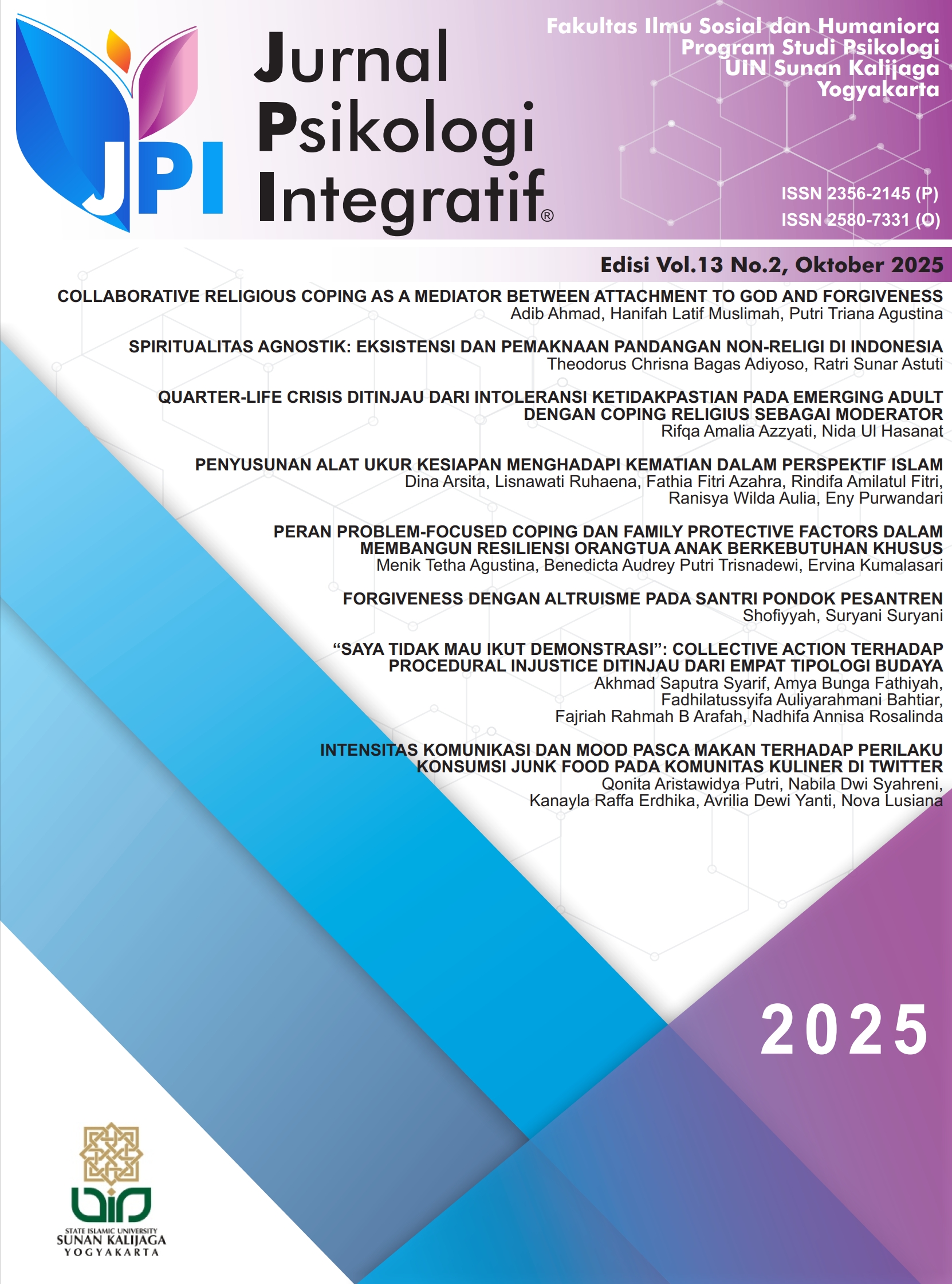
Spiritualitas Agnostik: Eksistensi dan Pemaknaan Pandangan Non-Religi di Indonesia
Main Article Content
 Theodorus Chrisna Bagas Adiyoso, S.Psi.
Ratri Sunar Astuti, M.Si.
Theodorus Chrisna Bagas Adiyoso, S.Psi.
Ratri Sunar Astuti, M.Si.
Abstract
Spirituality in Indonesia, often associated with religious adherents, becomes a separate question when associated with agnosticism. This study aims to describe the spirituality of agnostic individuals in Indonesia and its factors. Qualitative research methods were used, including deductive and inductive approaches, and the data was analyzed using the qualitative content analysis method. The data were obtained through semi-structured interviews with three agnostic individuals in Indonesia. The results showed that the three participants viewed God as existing but did not see from a religious perspective. The participants had illogical experiences and were associated with transcendent dimensions and luck. Informants have a life goal to be kind to others and are based on rationality and transcendent values. Informants consider that doing good is an observance of God. All three informants have been interested in philosophical views other than agnosticism. The factors underlying conversion and maintaining agnosticism in Indonesia are being critical of religious teachings and their adherents, not caring about people's comments, being kind without being religious, having a religion administratively, and being accepted by society. Based on their experiences and feelings, the three informants had experienced negative stigma from their social environment but felt free from religious demands.
Spiritualitas yang sering dikaitkan dengan umat beragama menjadi pertanyaan tersendiri jika dikaitkan dengan agnostisisme, khususnya di Indonesia. Penelitian ini bertujuan untuk mengetahui gambaran spiritualitas dan faktor pada individu agnostik di Indonesia. Metode yang digunakan dalam penelitian ini adalah penelitian kualitatif dengan pendekatan deduktif dan induktif, serta dianalisis dengan metode Analisis Isi Kualitatif (AIK). Data dalam penelitian ini didapatkan melalui wawancara semi-terstruktur pada tiga individu agnostik di Indonesia. Hasil penelitian menunjukkan ketiga informan memandang Tuhan itu ada tetapi tidak melihatnya dari perspektif agama. Ketiga informan mengakui pernah memiliki pengalaman yang tidak logis dan dikaitkan dengan dimensi transenden serta keberuntungan. Ketiganya memiliki tujuan hidup untuk berbuat baik pada sesama dan berprinsip pada rasionalitas serta nilai transenden. Ketiga informan menganggap bahwa berbuat baik adalah praktik spiritual kepada Tuhan. Ketiga informan mengaku pernah tertarik pada pandangan filosofis selain agnostisisme. Ditemukan pula faktor yang mendasari konversi dan alasan mempertahankan pandangan agnostisisme di Indonesia, yakni kritis terhadap ajaran agama dan penganutnya, tidak peduli pada komentar orang lain, dapat berbuat baik tanpa beragama, memiliki agama secara administratif, serta dimaklumi oleh lingkungannya. Berdasarkan pengalaman dan perasaan, ketiga informan pernah mendapat stigma negatif dari lingkungan sosial tetapi merasa bebas dari tuntutan agama.
Downloads
Article Details
License

This work is licensed under a Creative Commons Attribution-NonCommercial-ShareAlike 4.0 International License.
Authors who publish with this journal agree to the following terms:- Authors retain copyright and grant the journal right of first publication with the work simultaneously licensed under a Creative Commons Attribution License that allows others to share the work with an acknowledgement of the work's authorship and initial publication in this journal.
- Authors are able to enter into separate, additional contractual arrangements for the non-exclusive distribution of the journal's published version of the work (e.g., post it to an institutional repository or publish it in a book), with an acknowledgement of its initial publication in this journal.
- Authors are permitted and encouraged to post their work online (e.g., in institutional repositories or on their website) prior to and during the submission process, as it can lead to productive exchanges, as well as earlier and greater citation of published work (See The Effect of Open Access).
References

Article Sidebar
Stats:Download this article
PDF