Ejournal Home
 Search
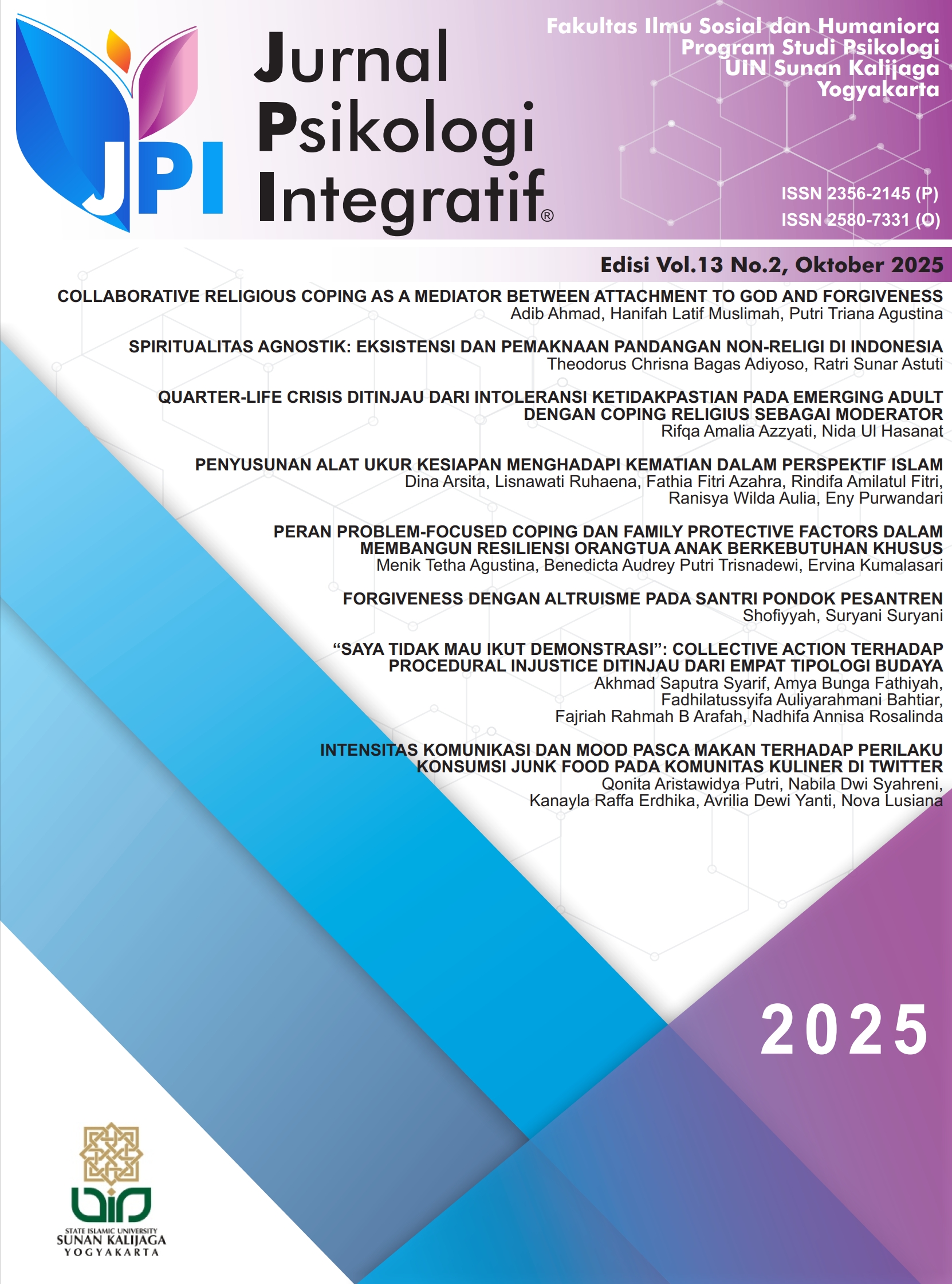
“Saya Tidak Mau Ikut Demonstrasi”: Collective Action terhadap Procedural Injustice Ditinjau dari Empat Tipologi Budaya
Main Article Content
 Akhmad Saputra Syarif
Amya Bunga Fathiyah
Fadhilatussyifa Auliyarahmani Bahtiar
Fajriah Rahmah B Arafah
Nadhifa Annisa Rosalinda
Akhmad Saputra Syarif
Amya Bunga Fathiyah
Fadhilatussyifa Auliyarahmani Bahtiar
Fajriah Rahmah B Arafah
Nadhifa Annisa Rosalinda
Abstract
This study aims to examine whether cultural typologies: vertical collectivism (VC), horizontal collectivism (HC), vertical individualism (VI), and horizontal individualism (HI), predict individuals’ intentions to engage in collective action in response to procedural injustice. The study employed a quantitative survey design involving 300 participants (67.67% female; 89% aged 18–30 years). Participants were presented with a procedural injustice vignette and subsequently completed the Individualism–Collectivism Scale (Triandis & Gelfand, 1998) and the Belief-Aligned Collective Action Scale (Cervone et al., 2023). Data were analyzed using multiple linear regression while controlling for age and gender. The findings indicate that vertical individualism significantly predicts higher intentions to engage in collective action (p < .001), whereas other cultural typologies do not show significant effects. These results suggest that individualistic orientations emphasizing competition and status differentiation may play a stronger role in motivating collective action under conditions of procedural injustice.
Penelitian ini bertujuan untuk menguji peran tipologi budaya; vertical collectivism (VC), horizontal collectivism (HC), vertical individualism (VI), dan horizontal individualism (HI), dalam memprediksi intensi individu untuk terlibat dalam aksi kolektif ketika menghadapi ketidakadilan prosedural. Penelitian ini menggunakan pendekatan kuantitatif dengan desain survei yang melibatkan 300 partisipan (67,67% perempuan; 89% berusia 18–30 tahun). Partisipan terlebih dahulu diberikan skenario ketidakadilan prosedural (vignette), kemudian diminta mengisi Individualism–Collectivism Scale (Triandis & Gelfand, 1998) dan Belief-Aligned Collective Action Scale (Cervone et al., 2023). Data dianalisis menggunakan regresi linier berganda dengan mengontrol variabel usia dan jenis kelamin. Hasil analisis menunjukkan bahwa hanya tipologi budaya vertical individualism yang secara signifikan memprediksi peningkatan intensi aksi kolektif (p < .001), sementara tipologi budaya lainnya tidak menunjukkan pengaruh yang signifikan. Temuan ini mengindikasikan bahwa orientasi individualistik yang menekankan kompetisi dan diferensiasi status memiliki peran yang lebih kuat dalam mendorong aksi kolektif dalam konteks ketidakadilan prosedural.
Downloads
Article Details
License

This work is licensed under a Creative Commons Attribution-NonCommercial-ShareAlike 4.0 International License.
Authors who publish with this journal agree to the following terms:- Authors retain copyright and grant the journal right of first publication with the work simultaneously licensed under a Creative Commons Attribution License that allows others to share the work with an acknowledgement of the work's authorship and initial publication in this journal.
- Authors are able to enter into separate, additional contractual arrangements for the non-exclusive distribution of the journal's published version of the work (e.g., post it to an institutional repository or publish it in a book), with an acknowledgement of its initial publication in this journal.
- Authors are permitted and encouraged to post their work online (e.g., in institutional repositories or on their website) prior to and during the submission process, as it can lead to productive exchanges, as well as earlier and greater citation of published work (See The Effect of Open Access).
References

Article Sidebar
Stats:Download this article
PDF