
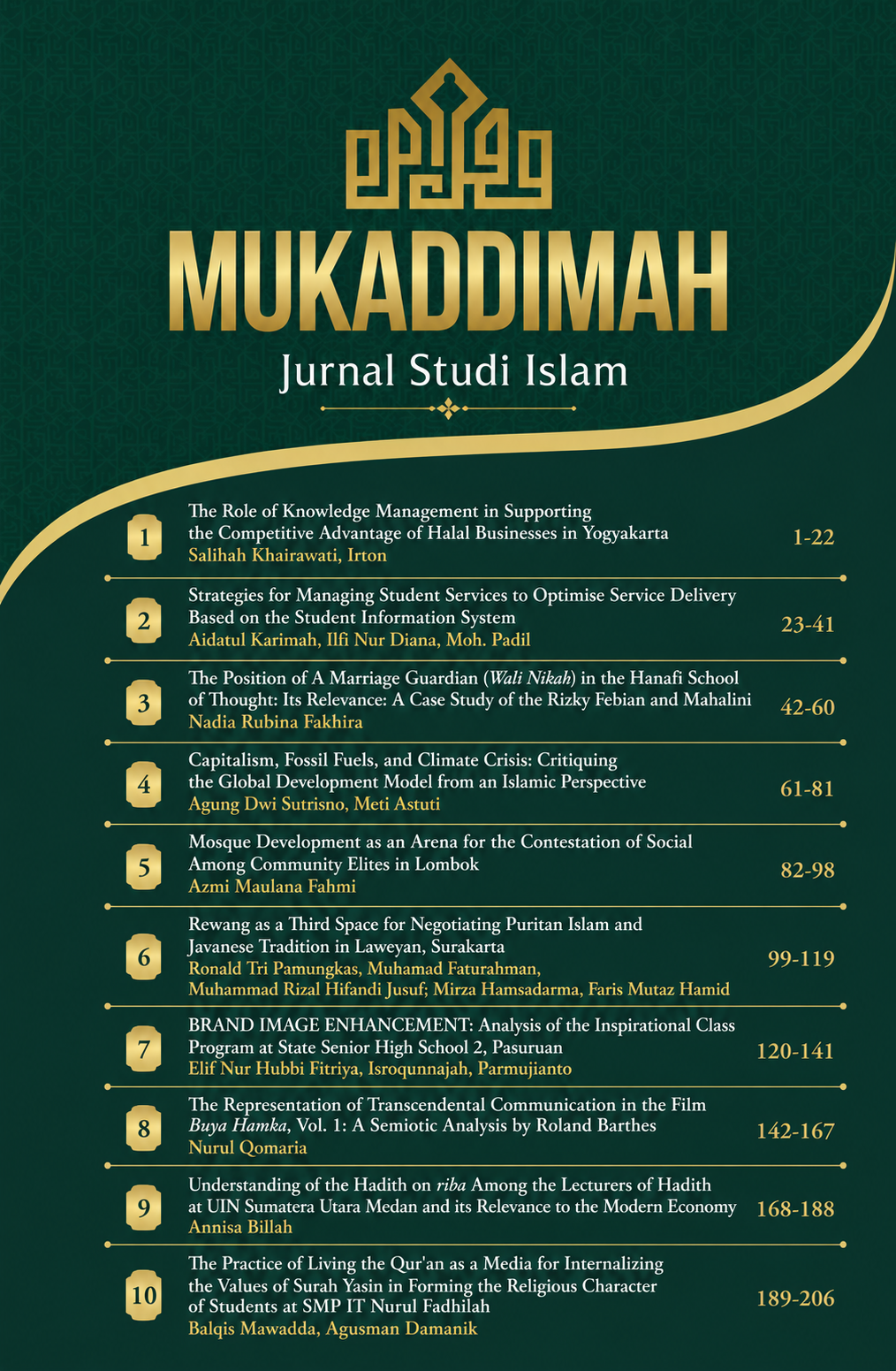
The Representation of Transcendental Communication in the Film Buya Hamka, Vol. 1: A Semiotic Analysis by Roland Barthes
DOI:
https://doi.org/10.14421/mjsi.v11i1.4943Abstract
This study aims to analyze the representation of transcendental communication in the film Buya Hamka Vol. 1 through Roland Barthes' semiotic approach and interpret it from the perspective of the Qur'an. The study employs a descriptive qualitative method, with the primary data source being Buya Hamka Vol. 1, directed by Fajar Bustomi. Data were collected through documentation of dialogues, visuals, expressions, and religious symbols containing values of transcendental communication. The analysis was conducted using Roland Barthes' three levels of semiotics: denotation, connotation, and myth, and was subsequently interpreted based on Qur'anic verses. The findings reveal that the film represents transcendental communication in three main dimensions: (1) transcendental communication through patience and trust in God (tawakkul) in facing life's trials; (2) transcendental communication through da'wah and the pursuit of knowledge as forms of worship and spiritual transformation; and (3) transcendental communication through steadfast monotheism (tawhid) and moral integrity in confronting socio-political pressures. This study offers a semiotic-theological reading model that integrates Roland Barthes' semiotics with the Qur'an-based concept of transcendental communication, thereby broadening the scope of Islamic communication studies in religious films.
Keywords: Transcendental Communication, Semiotics, Roland Barthes, Buya Hamka, Qur’an
References
Downloads
Published
Issue
Section
License
Copyright (c) 2026 Nurul Qomaria

This work is licensed under a Creative Commons Attribution-ShareAlike 4.0 International License.


