
Deteksi Dini Indikasi Risiko Keamanan Siber pada Game Online Berdasarkan Ulasan Pengguna Menggunakan Naive Bayes
DOI:
https://doi.org/10.14421/csecurity.2026.9.1.6034Abstract
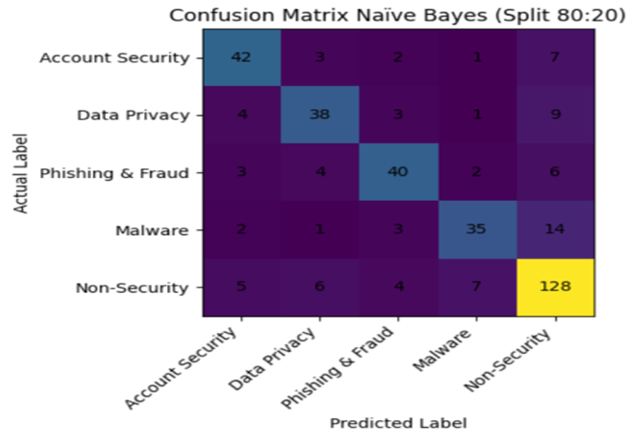
Game online merupakan platform digital yang mengelola data sensitif pengguna, termasuk informasi akun, data pribadi, dan transaksi digital, sehingga rentan terhadap berbagai ancaman keamanan siber. Sebagian besar penelitian sebelumnya memanfaatkan ulasan pengguna untuk analisis sentimen dan kualitas layanan, sementara pemanfaatannya sebagai indikator dini risiko keamanan siber masih terbatas. Penelitian ini bertujuan mengidentifikasi indikasi risiko keamanan siber pada game online berdasarkan ulasan pengguna sebagai bentuk user-reported cybersecurity signals. Sebanyak 3.069 ulasan pengguna Mobile Legends diproses melalui tahapan text mining (case folding, tokenizing, stopword removal, dan stemming), direpresentasikan menggunakan pembobotan TF-IDF, dan diklasifikasikan dengan algoritma Naïve Bayes. Kategori risiko meliputi Account Security Risk, Data Privacy Risk, Phishing & Fraud Risk, Malware Risk, serta Non-Security Issue. Evaluasi menggunakan skenario pembagian data 80:20 menunjukkan akurasi keseluruhan sebesar 76,5% berdasarkan confusion matrix, dengan variasi performa antar kategori. F1-score tertinggi diperoleh pada kategori Non-Security Issue (0,92), sedangkan Malware Risk terendah (0,67) akibat ambiguitas linguistik dalam narasi pengguna. Temuan ini menunjukkan bahwa ulasan pengguna berpotensi dimanfaatkan sebagai mekanisme deteksi dini berbasis komunitas. Secara teoretis, penelitian ini memperkenalkan pendekatan community-based cyber risk identification sebagai bentuk komplementer terhadap mekanisme deteksi teknis dalam manajemen risiko keamanan siber pada platform digital.
Kata kunci: keamanan siber, game online, text mining, naïve bayes, deteksi dini risiko
----------------------------------------------------------------------
Early Detection of Cybersecurity Risk Indications in Online Games Based on User Reviews Using Naive Bayes
Online games are digital platforms that manage sensitive user data, including account information, personal data, and digital transactions, making them vulnerable to various cybersecurity threats. Most previous studies have utilized user reviews for sentiment analysis and service quality evaluation, while their use as early indicators of cybersecurity risk remains limited. This study aims to identify indications of cybersecurity risks in online games based on user reviews as user-reported cybersecurity signals. A total of 3,069 user reviews of Mobile Legends were processed using text mining techniques, including case folding, tokenizing, stopword removal, and stemming. The textual data were represented using TF-IDF weighting and classified using the Naïve Bayes algorithm. The risk categories included Account Security Risk, Data Privacy Risk, Phishing & Fraud Risk, Malware Risk, and Non-Security Issue. Evaluation using an 80:20 data split scenario resulted in an overall accuracy of 76.5% based on the confusion matrix, with performance variations across categories. The highest F1-score was achieved in the Non-Security Issue category (0.92), while the Malware Risk category showed the lowest performance (0.67) due to linguistic ambiguity in user narratives. These findings indicate that user reviews have the potential to serve as a community-based early detection mechanism for cybersecurity risks. Theoretically, this study introduces a community-based cyber risk identification approach as a complementary mechanism to technical detection systems in cybersecurity risk management for digital platforms.
Keywords: cybersecurity; online games, text mining, naïve bayes, early risk detection
References
Downloads
Published
Issue
Section
License
Copyright (c) 2026 jely estianti, RG Guntur Alam, Agung Kharisma Hidayah

This work is licensed under a Creative Commons Attribution-ShareAlike 4.0 International License.
Attribution-ShareAlike 4.0 International (CC BY-SA 4.0)
You are free to:
- Share — copy and redistribute the material in any medium or format
- Adapt — remix, transform, and build upon the material for any purpose, even commercially.
Under the following terms:
- Attribution — You must give appropriate credit, provide a link to the license, and indicate if changes were made. You may do so in any reasonable manner, but not in any way that suggests the licensor endorses you or your use.
- ShareAlike — If you remix, transform, or build upon the material, you must distribute your contributions under the same license as the original.
- No additional restrictions — You may not apply legal terms or technological measures that legally restrict others from doing anything the license permits.


