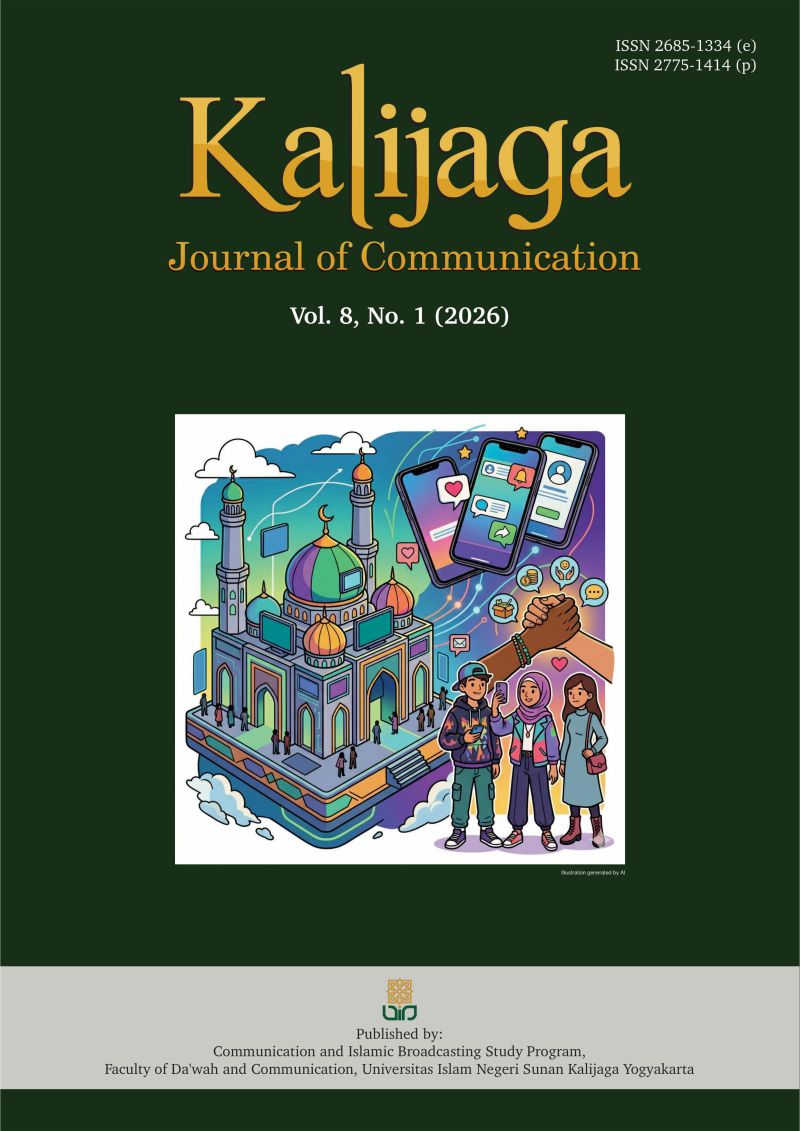
The Virtual Ummah Model as an Arena of Contestation and New Authority Formation for Muslim Gen Z
DOI:
https://doi.org/10.14421/kjc.81.09.2026Keywords:
virtual ummah, da'wah influencer, digital community, generation z, digital religious practicesAbstract
This research aims to develop a theoretical framework for the Virtual Ummah to understand the mechanisms underlying the formation of digital religious communities among Generation Z Muslims on Instagram and TikTok. The scope of the research includes a thematic synthesis of five primary studies from 2020–2025, encompassing quantitative studies, virtual ethnography, qualitative studies, and systematic reviews on da'wah practices and social contestation. The method used is a systematic literature synthesis with the stages of finding extraction, thematic coding based on framework indicators, and cross-study synchronization to reveal patterns, mechanisms, and contradictions in the formation of socio-religious bonds. The synthesis results show that the Virtual Ummah formation is hybrid and polarized, meaning there is a shift in religious authority from traditional institutions to da'wah influencers who utilize platform affordances such as comment features, duets, stitches, and the use of text and audio to create digital religious practices such as online murojaah, digital waqf organization, and social media-based communal rituals. The analysis also reveals the dynamics of contestation between moderate and non-moderate groups, as well as the potential for the spread of misinformation due to the lack of formal verification mechanisms. The main conclusion is that the Virtual Ummah is an adaptive religious community model that offers peer-to-peer learning opportunities and 24/7 spiritual accessibility. Still, it also presents serious challenges related to polarization and disinformation. Therefore, further studies should use primary data to delve deeper into motivations, experiences, and power dynamics.
References
Al-Zaman, A., Jamil, MM, Sobirin, M., & Taufiq, I. (2023). Muslims and social media: A scoping review. New Media & Society, 26(8), 4521–4540. https://doi.org/10.1080/1369118X.2024.2379835
Anderson, B. (2006). Imagined communities: Reflections on the origins and spread of nationalism (Revised ed.). Verso.
Brown, L. S., Nguyen, T. H., & Patel, R. (2024). Ethical considerations in secondary data analysis of social media content. Journal of Digital Ethics, 3(1), 15–30.
Campbell, H. A., & Tsuria, R. (2022). Digital religion: Understanding religious practice in digital media. Routledge.
Daulay, MRA (2025). Islam and the digital age: Building an Islamic generation through digital da'wah. INSIS: Journal of Information Science, 15(1), 45-62.
Grigore, C. (2025). The impact of digitalization on religious practices and community dynamics following the COVID-19 pandemic: A systematic review. Revista Romaneasca Pentru Educatie Multidimensionala, 17(2), 302-343. https://doi.org/10.18662/rrem/17.2/984
Johnston, M. P. (2019). Secondary analysis research: Common methodological pitfalls and how to avoid them. International Journal of Social Research Methodology, 22(2), 125–140.
Larsson, G. (2024). Muslims and social media: A scoping review. New Media & Society, 26(8), 4521–4540. https://doi.org/10.1080/1369118X.2024.2379835
Putri, DA, Sari, NM, & Kusumawardhani, A. (2021). TikTok as a Generation-Z Islamic learning media: Content analysis and pedagogical implications. Islamic Education Journal, 7(2), 101–118.
Rohmawati, HS (2025). Mediatization and hypermediation in digital religion and the transformation of Indonesian Muslim religious practices through social media usage. Journal of the Sociology of Religion, 18(1), 1-25. https://doi.org/10.14421/jsa.2024.182-01
Siregar, E. A., Tullaili, M., & Afdal, Z. (2025). Social media on Islamic lifestyle trends: A systematic literature review. Indonesian Interdisciplinary Journal of Sharia Economics, 8(1), 2270-2286.
Smith, J. A., & Jones, R. L. (2022). Quality assessment frameworks in secondary data research. Research Methods Quarterly, 10(3), 45–60.
Thalgi, M. J. (2024). Motivations for using religious digital media among university students: A hierarchical regression analysis. Millah: Journal of Religious Studies, 23(2), 883-912.
Thomas, J., & Harden, A. (2023). Methods for thematic synthesis in qualitative health care research. BMC Medical Research Methodology, 23(1), 12.
Wildan, M., Pratama, I., & Sugiarto, D. (2025). Gen Z Muslims, social contestation, and digital citizenship in Indonesia. Tribakti: Journal of Islamic Thought, 36(1), 165-182. https://doi.org/10.33367/tribakti.v36i1.6421
Zuhri, MK, Jamil, MM, Sobirin, M., & Taufiq, I. (2020). Virtual Ummah and religious movement contestation: Identity and discourse. AICIS Proceedings, 1(1), 245–260. https://doi.org/10.4108/eai.1-10-2019.2291667
Downloads
Published
Issue
Section
License
Copyright (c) 2026 Muh. Mahsya Nawaffani, Muh. Fajar Shodiq, Muh. Abyan Nugraha, Hamna Muzayyin

This work is licensed under a Creative Commons Attribution-NonCommercial-ShareAlike 4.0 International License.
Authors who publish with this journal agree to the following terms:
- Authors retain copyright and grant the journal right of first publication with the work simultaneously licensed under a Creative Commons Attribution-NonCommercial-ShareAlike 4.0 International License. that allows others to share and adapt the work with an acknowledgement of the work's authorship and initial publication in this journal.
- Authors are able to enter into separate, additional contractual arrangements for the non-exclusive distribution of the journal's published version of the work (e.g., post it to an institutional repository or publish it in a book), with an acknowledgement of its initial publication in this journal.
- Authors are permitted and encouraged to post their work online (e.g., in institutional repositories or on their website) prior to and during the submission process, as it can lead to productive exchanges, as well as earlier and greater citation of published work (See The Effect of Open Access).