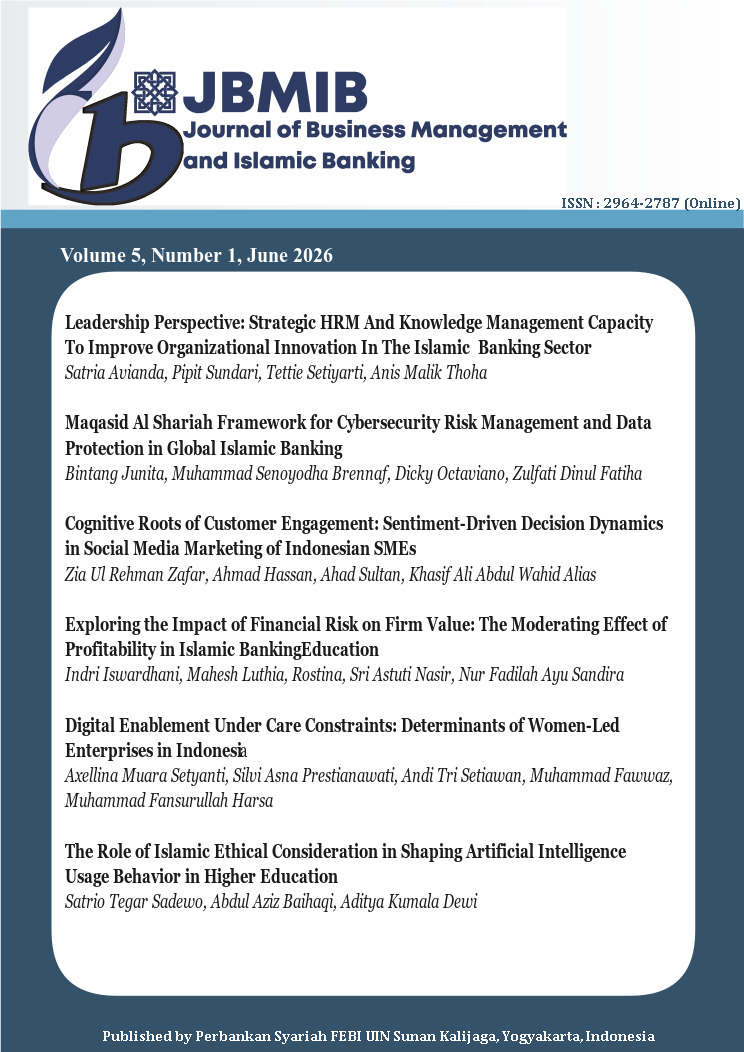
The Role of Islamic Ethical Consideration in Shaping Artificial Intelligence Usage Behavior in Higher Education
DOI:
https://doi.org/10.14421/jbmib.0501-01Keywords:
Islamic Ethical Consideration, Technology Acceptance Model, Artificial Intelligence, ChatGPT, Muslim StudentAbstract
Purpose—This study aims to examine the effects of perceived usefulness, perceived ease of use, and Islamic Ethical Consideration on ChatGPT usage behavior among Muslim university students in Indonesia.
Design/methodology/approach—A quantitative survey was conducted with 259 respondents and analyzed using Structural Equation Modeling–Partial Least Squares (SEM-PLS) to test both direct and indirect relationships within an extended Technology Acceptance Model.
Findings—The findings indicate that perceived usefulness significantly increases usage behavior (β = 0.241, p < 0.001). Perceived ease of use does not directly influence usage behavior (β = 0.065, p = 0.180) but shows a significant indirect effect through perceived usefulness (β = 0.119, p < 0.001). Islamic Ethical Consideration has a significant negative effect on usage behavior (β = −0.176, p = 0.006).
Research implication/limitation—This study is limited by its cross-sectional design and sample concentration, and it implies the need for ethically grounded AI guidance in higher education and broader future research.
Theoretical Contribution/Originality—This study extends TAM by showing that ChatGPT usage among Muslim students is shaped not only by functional perceptions but also by Islamic ethical considerations.
References
Al-Adwan, A. S., Li, N., Al-Adwan, A., Abbasi, G. A., Albelbisi, N. A., & Habibi, A. (2023). “Extending the Technology Acceptance Model (TAM) to Predict University Students’ Intentions to Use Metaverse-Based Learning Platforms”. Education and Information Technologies, 28(11), 15381–15413. https://doi.org/10.1007/s10639-023-11816-3
Alakrash, H. M., & Razak, N. A. (2021). Technology-based language learning: Investigation of digital technology and digital literacy. Sustainability, 13(21). https://doi.org/10.3390/su132112304
Alfani, D. S., Yuniarto, A., & Handrito, R. P. (2023). The Effect of Perceived Ease of Use on Intention to Use on Bank Syariah Indonesia Mobile Banking Users Mediated by E-Trust and Religiosity as Moderators. IJEBAS, 3(4), 1248–1259. https://doi.org/10.54443/ijebas.v3i4.1024
Alfiani, F. R. N., & Saptomo, A. (2024). Legal Framework for the Application of Pancasila-Based Artificial Intelligence Technology to Minimize Risks and Optimize Benefits Towards Indonesia Emas 2045. Asian Journal of Engineering, Social and Health, 3(4), 903–910. https://doi.org/10.46799/ajesh.v3i4.365
Alsmadi, A. A., Aalrawashdeh, N., Al-Gasaymeh, A., Alhazimeh, A. M., & Alhawamdeh, L. (2024). Adoption of Islamic Fintech in Lending Services Through Prediction of Behavioural Intention. Kybernetes, 53(6), 1921–1938. https://doi.org/10.1108/K-10-2022-1362
Al-Suqri, M. N. (2014). Perceived usefulness, perceived ease-of-use and faculty acceptance of electronic books. Library Review, 63(4–5), 276–294. https://doi.org/10.1108/LR-05-2013-0062
Ardian, R., Putra, Ahmad, S., & Rahman, F. M. (2023). Influence of PU and PEOU on Behavioral Intention for BRImo Users. Journal of Economics, Finance and Management Studies, 6(12), 5917–5921. https://doi.org/10.47191/jefms/v6-i12-18
Darmansyah, Fianto, B. A., Hendratmi, A., & Aziz, P. F. (2020). Factors determining behavioral intentions to use Islamic financial technology. Journal of Islamic Marketing, 12(4), 794–812. https://doi.org/10.1108/JIMA-12-2019-0252
Davis, F. D. (1989). Perceived usefulness, perceived ease of use, and user acceptance of information technology. MIS Quarterly, 13(3), 319–340. https://doi.org/10.2307/249008
Dhewandrie, G. S. A., & Yuniawan, A. (2023). Exploring Factors Influencing Technology Adoption among Generation Y. Jurnal Manajemen Dan Kewirausahaan, 11(1), 57–65. https://doi.org/10.26905/jmdk.v11i1.10202
Gangwar, H., Date, H., & Ramaswamy, R. (2015). Understanding determinants of cloud computing adoption using an integrated TAM-TOE model. Journal of Enterprise Information Management, 28(1), 107–130. https://doi.org/10.1108/JEIM-08-2013-0065
Hair, J. F., Black, W. C., Babin, B. J., & Anderson, R. E. (2014). Multivariate Data Analysis (7th ed.). Pearson Education Limited. https://doi.org/10.1002/9781118595041
Han, J. H., & Sa, H. J. (2022). Acceptance and satisfaction with online educational classes. Asia Pacific Education Review, 23(3), 403–415. https://doi.org/10.1007/s12564-021-09716-7
Ibrahim, M. H., Fitri, F., & Ahmad, R. S. (2024). Technology Readiness in Islamic Financial Technology Acceptance. Al-Muzara’ah, 12(1), 177–194. https://doi.org/10.29244/jam.12.1.177-194
Kim, Y., Blazquez, V., & Oh, T. (2024). Determinants of Generative AI System Adoption and Usage Behavior in Korean Companies. Behavioral Sciences, 14(11). https://doi.org/10.3390/bs14111035
Li, L., Zhang, M., Chandio, A. A., & Liu, Y. (2024). Intention and Behavior of Vegetable Farmers to Adopt IoT Technology. Frontiers in Sustainable Food Systems, 8. https://doi.org/10.3389/fsufs.2024.1340874
Liu, C., & Wu, Y. (2020). Value-Belief-Norm Theory and TAM on Use Intention of Green Packaging. International Journal of Business and Management, 15(7), 158–170. https://doi.org/10.5539/ijbm.v15n7p158
Mardhiah, A., Farisha, N., Yuan, W. P., & Tony, F. N. (2022). Influence of Perceived Ease of Use and Perceived Usefulness on Housekeeping Technology. IJARBSS, 12(11), 1306–1314. https://doi.org/10.6007/ijarbss/v12-i11/15657
Mohadi, M., & Tarshany, Y. (2023). Maqasid Al-Shari’ah and the Ethics of Artificial Intelligence: Contemporary Challenges. Journal of Contemporary Maqasid Studies, 2(2), 79–102. https://doi.org/10.52100/jcms.v2i2.107
Nadal, C., Sas, C., & Doherty, G. (2020). Technology acceptance in mobile health. Journal of Medical Internet Research, 22(7). https://doi.org/10.2196/17256
Pillai, R., & Sivathanu, B. (2020). Adoption of AI-based chatbots for hospitality and tourism. International Journal of Contemporary Hospitality Management, 32(10), 3199–3226. https://doi.org/10.1108/IJCHM-04-2020-0259
Putra, I. S., Triatmanto, B., & Zuhro, D. (2021). Effect of PEOU on Intention to Use E-learning with Moodle. Management and Economics Journal, 5(3), 211–220. https://doi.org/10.18860/mec-j.v5i3.13146
Raquib, A., Channa, B., Zubair, T., & Qadir, J. (2022). Islamic virtue-based ethics for artificial intelligence. Discover Artificial Intelligence, 2(1), 11. https://doi.org/10.1007/s44163-022-00028-2
Ratten, V. (2012). Entrepreneurial and ethical adoption behaviour of cloud computing. The Journal of High Technology Management Research, 23(2), 155–164. https://doi.org/10.1016/j.hitech.2012.06.006
Sallam, M., Elsayed, W., Al-Shorbagy, M., Barakat, M., El Khatib, S., Ghach, W., Alwan, N., Hallit, S., & Malaeb, D. (2024). ChatGPT usage and attitudes are driven by perceptions of usefulness, ease of use, risks, and psycho-social impact: A study among university students in the UAE. Frontiers in Education, 9. https://doi.org/10.3389/feduc.2024.1414758
Serevan, B. (2025). Al-Ghazali’s principle of trust (Amanah) as a framework for ethical AI governance in organizations. AI and Ethics, 5(5), 5273–5282. https://doi.org/10.1007/s43681-025-00780-y
Sodik, F., Zaida, A. N., & Zulmiati, K. (2022). Analisis Minat Penggunaan pada Fitur Pembelian Mobile Banking BSI: Pendekatan TAM dan TPB. Journal of Business Management and Islamic Banking, 35–53. https://doi.org/10.14421/jbmib.2022.011-03
Sukainah, A., Reski, P. P., Fadilah, R., & Mustarin, A. (2019). Application of TAM to E-learning Assessment in Agricultural Technology Education. Journal of Physics Conference Series, 1387(1). https://doi.org/10.1088/1742-6596/1387/1/012115
Venkatesh, V., & Davis, F. D. (2000). A Theoretical Extension of the Technology Acceptance Model. Management Science, 46(2), 186–204. https://doi.org/10.1287/mnsc.46.2.186.11926
Widyaningrum, P. W., Astuti, E. S., Yulianto, E., & Mawardi, M. K. (2025). User Experience as a Predictor of E-commerce Continuation Intention in Indonesia: Examining the Role of Shopping Orientation as a Moderator. Journal of Information Systems Engineering and Business Intelligence, 11(2), 187–199. https://doi.org/10.20473/jisebi.11.2.187-199
Zahrani, A. A. (2021). Behavior Control and Actual Use of MOOC System for Education Sustainability. Entrepreneurship and Sustainability Issues, 9(1), 386–400. https://doi.org/10.9770/jesi.2021.9.1(24)
Zhonggen, Y., & Xiaozhi, Y. (2019). An Extended Technology Acceptance Model of a Mobile Learning Technology. Computer Applications in Engineering Education, 27(3), 721–732. https://doi.org/10.1002/cae.22111
Downloads
Published
Issue
Section
License
Copyright (c) 2026 Journal of Business Management and Islamic Banking

This work is licensed under a Creative Commons Attribution-ShareAlike 4.0 International License.
 All publication from Journal of Business Management and Islamic Banking are licensed under a Creative Commons Attribution-ShareAlike