
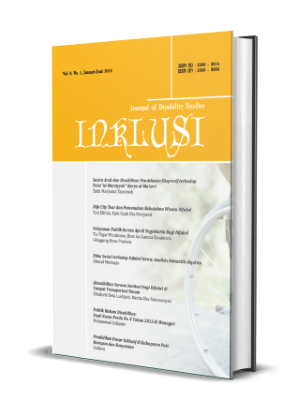
INKLUSI: Journal of Disability Studies is an accredited, peer-reviewed academic journal focusing on disability as a social, cultural, political, and rights-based phenomenon. The journal publishes scholarly works addressing disability issues, the rights of persons with disabilities, inclusive education, and broader efforts toward social inclusion.
INKLUSI adopts an interdisciplinary approach, welcoming contributions from various fields while maintaining disability as a central focus of analysis. The journal is published by the Center for Disability Services, Universitas Islam Negeri Sunan Kalijaga, Yogyakarta, Indonesia, and accepts original, research-based articles that demonstrate clear theoretical grounding and academic rigor.
The publication of INKLUSI is supported by KOPERTINA (Indonesian Inclusive Higher Education Consortium), a network of universities committed to advancing inclusive higher education in Indonesia.

Musãwa Journal of Gender and Islamic Studies was first published in March 2002 by PSW (Pusat Studi Wanita) Sunan Kalijaga Yogyakarta under contribution with the Royal Danish Embassy Jakarta. In 2008, published twice a year in collaboration with TAF (The Asia Foundation), namely January and July.
Musãwa Journal is a study of gender and Islam especially on gender mainstreaming and child rights both in the study of texts in the Qur’an and Hadith, figures and thoughts, history and repertoire, classical and contemporary literature as well as socio-cultural studies. All concentrations are in the context of Indonesia and other countries in Southeast Asia within the framework of unified NKRI, based on Pancasila.
Musãwa Journal has been published by PSW UIN Sunan Kalijaga Yogyakarta since 2002. Initiated by lecturers, gender activists and Islamic studies scholars of PTKI ( Higher Education of Islamic Religion) Musãwa has regularly published academic works and researches on gender and Islam for almost two decades. Now, the Journal extends its studies with Children and Human Rights (HAM). All studies are still in the context of gender and its mainstreaming. Through the studies hopefully, the Musawa journal can be part of the implementation of gender mainstreaming in the context of Indonesian society.

 | Panangkaran: Jurnal Penelitian Agama dan Masyarakat is a scholarly journal published by the Association of Religious Studies Researchers in collaboration with the Center for Research and Publication, Institute for Research and Community Service (LP2M), UIN Sunan Kalijaga Yogyakarta. The journal serves as a platform for disseminating original research and scholarly contributions by researchers, scholars, and academics. It aims to facilitate, disseminate, and foster critical dialogue on scholarly discourses in the field of socio-religious studies. The journal publishes original research articles as well as critical and theoretically informed studies addressing a broad range of issues related to religion and social life, intellectual and educational studies, religious education, and the relationship between religion and science. Panangkaran: Jurnal Penelitian Agama dan Masyarakat was first established in 2017 and has been nationally accredited by the Ministry of Research, Technology, and Higher Education of the Republic of Indonesia under Decree No. 200/M/KPT/2020. The journal is published biannually, in June and December. |

Aplikasia: Jurnal Aplikasi Ilmu-Ilmu Agama (E-ISSN 2598-2176) is a peer-reviewed, open-access journal focusing on a university-community research and engagement program to advance theories, researches, and practices related to outreach and community service. Published by LPPM (Lembaga Penelitian dan Pengabdian kepada Masyarakat) of UIN Sunan Kalijaga Yogyakarta biannually in June and December.

Mukaddimah: Jurnal Studi Islam is a multidisciplinary academic journal published by Kopertais Region III Yogyakarta. The articles published include Islamic studies that are reviewed from various perspectives, ranging from communication, anthropology, education, economics, sociology, philology, education, philosophy, etc. This journal is dedicated to academics, experts, and observers in Islamic Studies. Published articles must be original works and do not have to be in line with the editor's views.
| Original title | : | Mukaddimah: Jurnal Studi Islam |
| English title | : | Mukaddimah: Journal of Islamic Studies |
| Short title | : | Mukaddimah |
| Abbreviation | : | Mukaddimah |
| Frequency | : | 2 issues per year (June and December) |
| Number of articles per issue | : | 10 research articles and reviews per issue |
| DOI | : | 10.14421/mjsi |
| ISSN | : | 2579-4957 (Printed); 2338-6924 (Online) |
| Editor-in-Chief | : | Abd. Aziz Faiz |
| Publisher | : | Kopertais III D.I. Yogyakarta St. Laksda Adisucipto, Sleman, D. I. Yogyakarta 55281, Indonesia |
| Language | : | Bahasa, English |
| Citation Analysis | : | Sinta, Google Scholar, Garuda |
| Subject Area; Category | : | Arts and Humanities; Religious Studies |
| Discipline | : | Islamic Studies |
INTACT Journal: Integrative Studies in Islam, Science, and Society is an international, peer-reviewed, open-access journal devoted to fostering high-quality scholarship that bridges Islamic intellectual traditions, scientific inquiry, and societal transformation within a rigorous integrative and interdisciplinary framework.
The journal welcomes original research and conceptual contributions that critically address contemporary questions in Islam, science, education, psychology, and public life. With a commitment to intellectual excellence, interdisciplinary dialogue, and scholarly relevance, INTACT Journal aims to generate transformative perspectives and innovative frameworks of knowledge that contribute meaningfully to contemporary academic discourse and global civilization.
Published by the Centre for Integrative–Interconnected Transformative Studies (CIINTRA), UIN Sunan Kalijaga Yogyakarta, Indonesia, INTACT Journal envisions itself as a reputable global platform for scholars and practitioners who seek to advance integrative thought, deepen academic engagement, and strengthen the role of knowledge in shaping a more enlightened, ethical, and humane future.