
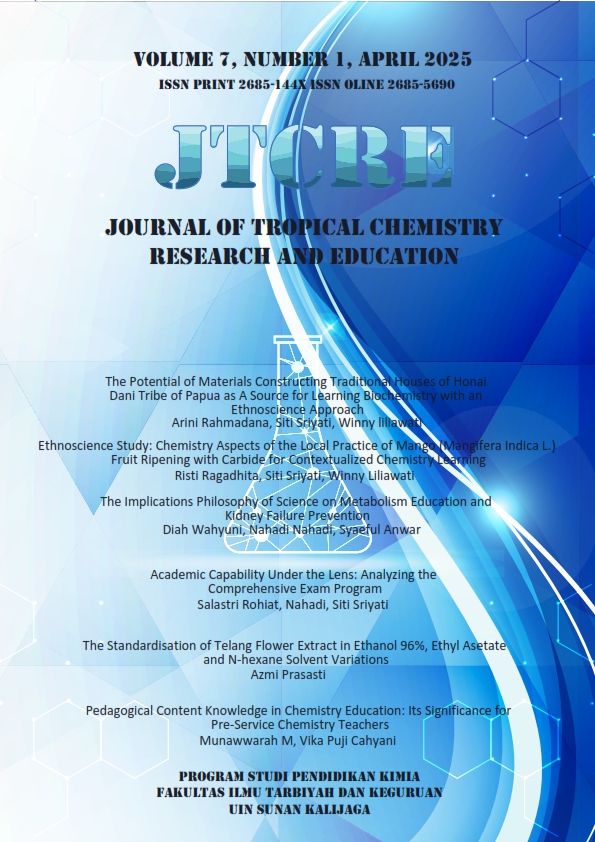
Academic Capability Under the Lens: Analyzing the Comprehensive Exam Program
DOI:
https://doi.org/10.14421/jtcre.2025.71-04Keywords:
comprehensive examination, academic ability, evaluationAbstract
This program evaluation is intended to describe the results of the comprehensive examination program for prospective teachers in all science fields. The results of this program evaluation are expected to make a specific contribution to the sustainability of the comprehensive examination program being held and are expected to contribute to education in general. This program evaluation uses the CIPP (Context, Input, Process and Product) evaluation model. Data sources for this program evaluation consist of documents and human resources. Based on the results of a thorough evaluation of the comprehensive examination program, it can be concluded that recommendations to improve the effectiveness and sustainability of this program are very important. Evaluations covering context, input, process and product aspects show that there are several areas that need to be improved and improved. An effective and sustainable comprehensive examination program is not only an evaluation tool, but also an integral part of their academic and professional career development. With a holistic and sustainable approach, study programs can ensure that comprehensive exams provide maximum benefits for students and educational institutions as a whole.
References
Ali, S. S. (2019). Problem based learning: A student-centered approach. English language teaching, 12(5), 73-78.
Arifin, Z. (2012). Evaluasi Pembelajaran. Jakarta: Direktorat Jenderal Pendidikan Islam Kementerian Agama RI.
Benn, C. (2021). Effective comprehensive education. In Affirming the Comprehensive Ideal (pp. 121-136). Routledge.
Bili, S., Suparmi, S., & Sarwanto, S. (2022). Problem-based Learning: Improving Students’ Concept Mastery and Learning Activities. Journal of Educational Science and Technology (EST), 8(1), 25.
Cevallos, M. A. S., Rosado, C. A. Z., & Terán, O. V. T. 2019. The procedure used on diagnostic evaluation process. International Journal of Health & Medical Sciences, 3(1), 1-10. https://doi.org/10.31295/ijhms.v3n1.98
Duggan-Haas. 1999. A Proposed Introduction to the NSTA Standards for Science Teacher Preparation. Kalamazoo College
Folkman, S. (2020). Stress: appraisal and coping. In Encyclopedia of behavioral medicine (pp. 2177-2179). Cham: Springer International Publishing.
Fuller, M. B. (2012). Realizing higher education’s humanizing potential: Assessment as a dialogical act. Social justice, competition and quality: 21st century leadership challenges, 145-156.
Haryanto, M. P. (2020). Evaluasi pembelajaran (konsep dan manajemen). UNY Press.
Herring, M. C., Koehler, M. J., & Mishra, P. (Eds.). (2016). Handbook of technological pedagogical content knowledge (TPACK) for educators (Vol. 3, pp. 189-200). New York: Routledge.
Hung, W., & Amida, A. (2020). Problem-Based Learning in college science. Active learning in college science: The case for evidence-based practice, 325-339.
Jossey-Bass.Marshall, S., Sweller, J. (1999). Comprehensive Testing in Education: A Performance-Based Learning Approach. Journal of Educational Psychology, 91(3), 574-580.
Kirkpatrick, D., & Kirkpatrick, J. (2006). Evaluating training programs: The four levels. Berrett-Koehler Publishers.
Misra, R., McKean, M. (2000). The Importance of Comprehensive Examinations in Higher Education: A Literature Review. Journal of College Student Development, 41(6), 767-780
Mulyatiningsih, E. (2015). Metode penelitian terapan bidang pendidikan. Uny Press.
Mustofa, M. (2007). Upaya pengembangan profesionalisme guru di indonesia. Jurnal Ekonomi dan Pendidikan, 4(1), 17245.NRC. (1996). National Science Education Standard. Washington DC: National Academy Press
Noorjannah, L. (2014). Pengembangan Profesionalisme Guru melalui Penulisan Karya Tulis Ilmiah Bagi Guru Profesional di SMA Negeri 1 Kauman Kabupaten Tulungagung. Jurnal humanity, 10(1).
Purwaningsih, A. Y., & Herwin, H.(2020). Pengaruh regulasi diri dan kedisiplinan terhadap kemandirian belajar siswa di sekolah dasar. Jurnal Penelitian Ilmu Pendidikan, 13(1), 22-30.doi:https://doi.org/10.21831/jpipfip.v13i1.29662
Saunders-Scott, D., Braley, M. B., & Stennes-Spidahl, N. (2018). Traditional and psychological factors associated with academic success: Investigating best predictors of college retention. Motivation and emotion, 42, 459-465.
Shinkfield, A. J. (2007). Evaluation theory, models, and applications. Jossey-Bass.
Stufflebeam, D. L. (2015). CIPP evaluation model checklist: A tool for applying the CIPP model to assess projects and programs. Western Michigan University Evaluation Center.
Tinto, V. (2012). Leaving college: Rethinking the causes and cures of student attrition. University of Chicago press.
Wahiddah, S. A. N. & Julia, J. (2022). Afirmasi positif: Booster untuk meminimalisir hambatan belajar pada siswa sekolah dasar. Jurnal Penelitian Ilmu Pendidikan, 15(2), 189-199. DOI:https://doi.org/10.21831/jpipfip.v15i2.50910
Widoyoko, E. P. (2012). Evaluasi program pembelajaran. Yogyakarta: pustaka pelajar
Wu, X. (2021). Research on Comprehensive Evaluation of Higher Education. Methodology, 4(3), 40-44.
Zhang, L. (2020). Comprehensive analysis of students' performance based on student comprehensive analysis model. Academic Journal of Computing & Information Science, 3(4), 66-72.


.jpg)


