
328
Views
846
Downloads
 Open Access
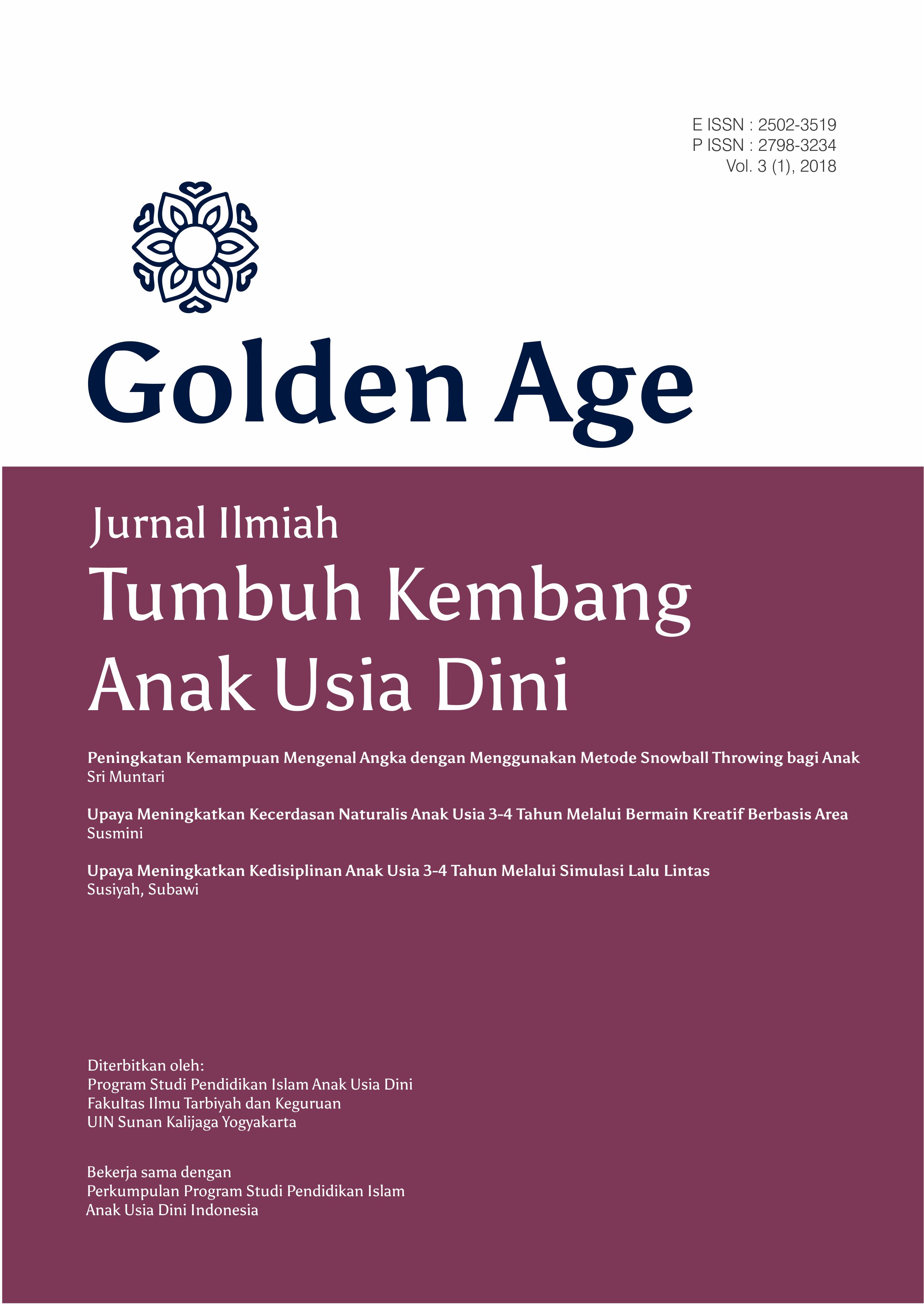
Peningkatan Kemampuan Mengenal Angka dengan Menggunakan Metode Snowball Throwing bagi Anak
Main Article Content
Abstract
This study aims to determine the ability to recognize the numbers of students in Group A TK Widya Tama Cabak and the use of the snowball throwing method can improve the ability to recognize the numbers of students in Group A TK Widya Tama Cabak Academic Year 2016/2017. The subjects studied were 31 students of group A TK Widya Tama Cabak. Data collection techniques using observation, interview, and documentation techniques. The data analysis technique uses descriptive qualitative and comparative. The research procedure consists of two cycles, namely: cycle I and cycle II, with each of the four stages of each cycle, namely: (1) planning the action (planning), (2) implementing the action (acting), (3) observing ( observing), and (4) reflection (reflecting). The results of the study concluded that: (1) Ability to recognize the numbers of students in Group A Widya Tama Cabak Kindergarten in the 2016/2017 Academic Year before the action was taken, namely at the pre-cycle level was still low. The ability to recognize the number of children included in the BSB and BSH categories in the pre-cycle was only 10 children (32.26%). (2) The use of the snowball throwing method can increase the ability to recognize the numbers of students in Group A TK Widya Tama Cabak for the 2016/2017 Academic Year. This is evidenced from: (a) Increasing the ability to recognize the number of children included in the BSB and BSH categories starting from the pre cycle, cycle I to cycle II, namely: the new pre cycle of 32.26%, the first cycle becomes 64.52% and the cycle II to be 90.32%. (b) Increasing the average value of the ability to recognize the number of children starting from the pre-cycle, the first cycle to the second cycle, namely: pre-cycle of 11.61 which included the Emerging (MM) category, cycle I increased to 13.16 which included the category Developing according to Expectations (BSH) and the second cycle the score increased again to 15.39 and included the Expectation Development Expectation (BSH) category.
Keywords:
Article Details
How to Cite
Copyright
Copyright Notice
Authors who publish with this journal agree to the following terms:
- Authors retain copyright and grant the journal the right of first publication with the work simultaneously licensed under a Creative Commons Attribution-NonCommercial 4.0 International License that allows others to share the work with an acknowledgment of the work's authorship and initial publication in this journal, provided that the work is not used for commercial purposes.
- Authors can enter into separate, additional contractual arrangements for the non-exclusive distribution of the journal's published version of the work (e.g., post it to an institutional repository or publish it in a book), with an acknowledgement of its initial publication in this journal.
- Authors are permitted and encouraged to post their work online (e.g., in institutional repositories or on their website) prior to and during the submission process, as it can lead to productive exchanges, as well as earlier and greater citation of published work.
Privacy Statement
The names and email addresses entered in this journal site will be used exclusively for the stated purposes of this journal and will not be made available for any other purpose or to any other party.