Transnational Da'wah and Migrant Community Empowerment
A Case Study of Pesantren An-Nahdloh in Malaysia

Downloads
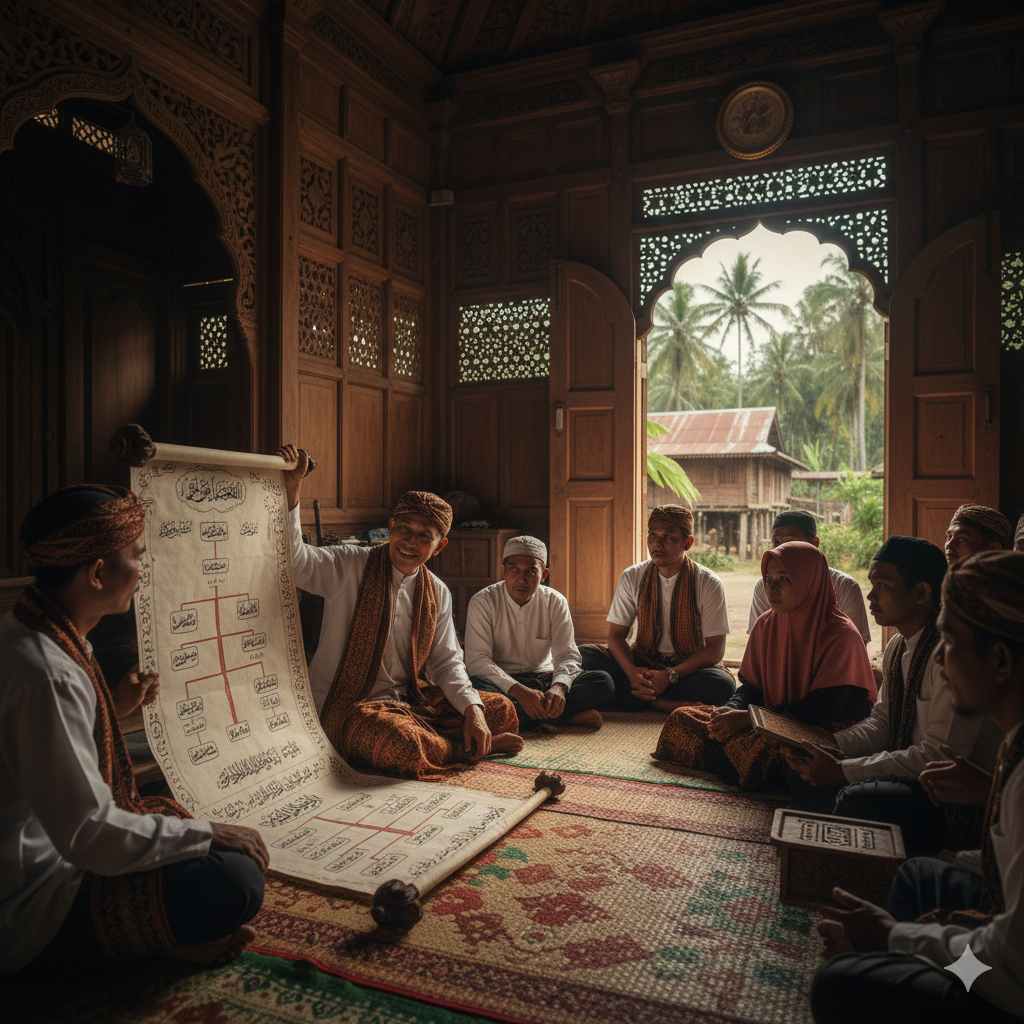
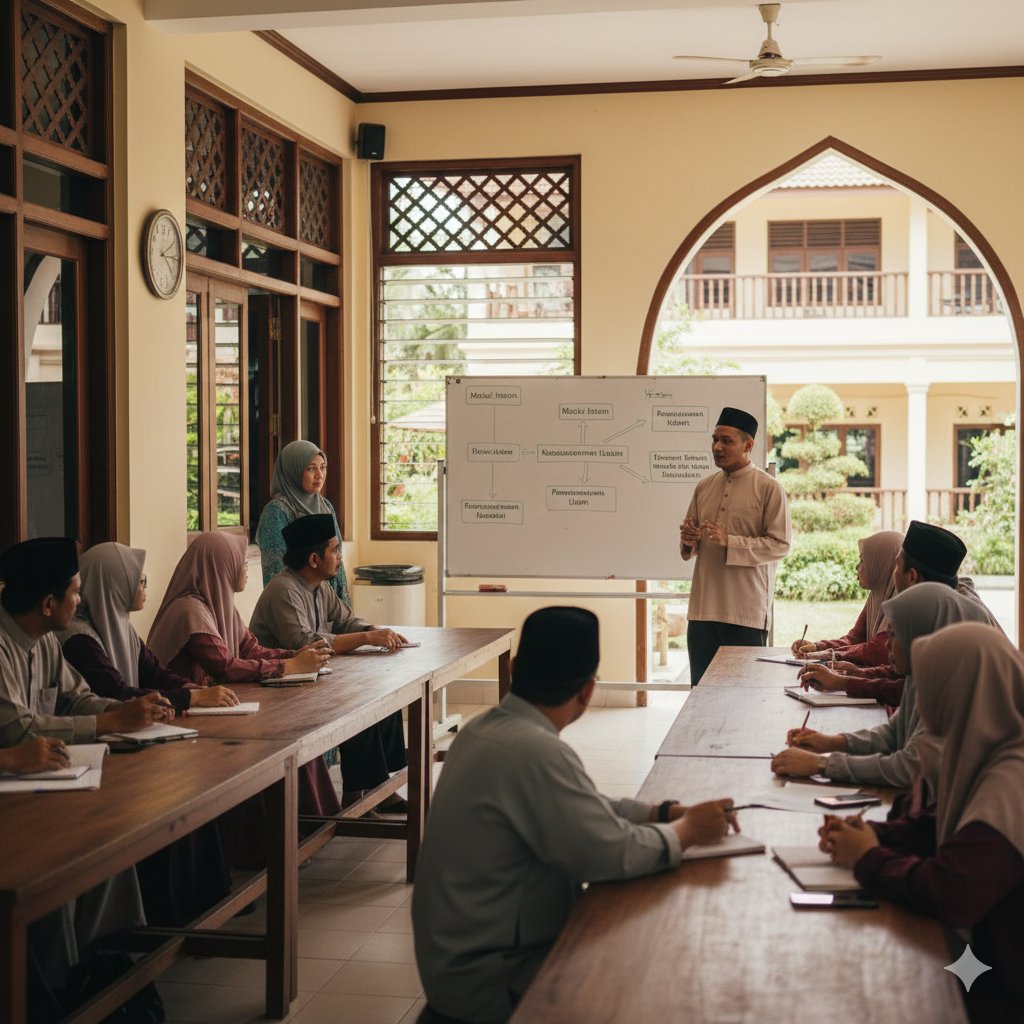
This paper explores the dynamics of transnational da'wah and community empowerment through the case of Pesantren An-Nahdloh in Malaysia, a pesantren established by Indonesian Nahdlatul Ulama (NU) migrants. The central question concerns how a pesantren initiated and funded by migrant workers can function as a medium of da'wah and social empowerment beyond national borders. Positioned within the discourse of transnational Islamic movements and grassroots religious communication, this study adopts a qualitative-descriptive method using document analysis and contextual observation. The discussion reveals that the pesantren operates not only as an Islamic educational institution but also as a center for da'wah bil hal addressing social, moral, and educational needs of Indonesian migrant communities. This model demonstrates how da'wah institutions initiated by civil society actors can facilitate cultural resilience, religious moderation, and local empowerment in diaspora settings.
Abu Bakar, “Social Media in Islamic Education: Trends and Opportunities.” Journal of Islamic Media Studies, 15, no. 2 (2021): 36-49. https://doi.org/10.1234/jims.2021.0024.
Adam, Abdussalam A. ‘The Feminisation of Migration and the Practice of Religion’. E-Journal of Humanities Arts and Social Sciences, 2023, 1232–42. https://doi.org/10.38159/ehass.20234106.
Al-Attas, Islamic Education: Its Meaning and Approach. Kuala Lumpur: ISTAC, 1999.
Al-Mansur, “Digital Tools in Da’wah: Reaching the Global Ummah.” Journal of Islamic Digital Studies, 23, no. 1 (2019): 59-72. https://doi.org/10.2345/jids.2019.0019.
Alifuddin, Muhammad, Rosmini Rosmini, and Risman Iye. ‘Da’wah Bil Hal: A Study of Muhammadiyah’s Social Movements in Wolo During the Political Dynamics of the Old and New Order Eras’. Ilmu Dakwah Academic Journal for Homiletic Studies 18, no. 1 (2024): 133–52. https://doi.org/10.15575/idajhs.v18i1.19225.
Atassi, “Transnational Da’wah in the Digital Age.” Global Muslim Politics Review, 2020. https://gmpreview.org/transnational-dawah (accessed April 21, 2025).
D’Souza, Jayesh. ‘Community Resilience and Migration: Using Best Evidence Synthesis to Promote Migrant Welfare’, 2023. https://doi.org/10.21203/rs.3.rs-3200991/v1.
Fakhri, Mohammad. ‘Phenomenological Study on Religious Values Development in Children of Muslim Migrant Workers Families in Lombok Island’. Khazanah Sosial 6, no. 1 (2024): 174–82. https://doi.org/10.15575/ks.v6i1.33612.
Firdaus, Rizki A., Sunarto Sunarto, Hadi Cahyono, Ambiro P. Asmaroini, and Muhammad K. Umam. ‘Models of Multicultural Education in Efforts to Grow Tolerance in the Guidance Center of SMP an Nahdloh Malaysia’. Qalamuna Jurnal Pendidikan Sosial Dan Agama 15, no. 2 (2023): 887–96. https://doi.org/10.37680/qalamuna.v15i2.3128.
Gunawan, Reka, and Abdul Muhid. ‘The Strategy of Da’wah Bil Hal Communication: Literature Review’. Komunike 14, no. 1 (2022): 33–50. https://doi.org/10.20414/jurkom.v14i1.5270.
Hasan, Islam dan Pemberdayaan Masyarakat Migran. Journal of Islamic Social Studies 22, no. 4 (2020): 59-78. https://doi.org/10.1234/jiss.2020.0012.
Karimullah, Suud S. ‘Influence of Progressive Islamic Da’wah on Economic Empowerment Within the Muslim Community’. Journal of Da Wah 2, no. 2 (2023): 150–74. https://doi.org/10.32939/jd.v2i2.3017.
Kholis, Nor, M Mudhofi, Nur Hamid, and Elvara N. Aroyandin. ‘Dakwah Bil-Hal Kiai Sebagai Upaya Pemberdayaan Santri (Action Da’wah by the Kiai as an Effort to Empower Students)’. Jurnal Dakwah Risalah 32, no. 1 (2021): 112. https://doi.org/10.24014/jdr.v32i1.12866.
Levi, Joseph A. ‘Identity Matters: Culture and Religion as Key Factors in the Migration of Muslims’. Migration & Diversity 3, no. 1 (2024): 29–50. https://doi.org/10.33182/md.v3i1.3157.
Mahendra, Sandya, Engine Kubota, Nabila R. Rama, and M. Junaidi. ‘Implementation of Law Number 18 of 2019 on Access to Education for Graduates of Muhammadiyah Boarding School Klaten at State Universities’. Journal of Transcendental Law 3, no. 2 (2022): 141–55. https://doi.org/10.23917/jtl.v3i2.18509.
Nabil, “Da’wah in the Age of Technology: A New Paradigm for Muslim Communities.” International Journal of Islamic Studies, 27, no. 4 (2020): 98-112. https://doi.org/10.5678/ijis.2020.0045.
Nawawi, Islam Nusantara dan Moderasi Beragama. Yogyakarta: LKiS, 2022.
Nisa, “Peran Pesantren di Komunitas Migran.” Jurnal Pendidikan Islam Global, 2021. https://jurnalislamglobal.com/peran-pesantren-di-komunitas-migran/ (accessed April 21, 2025).
Nordin, “Challenges in Digital Da’wah: A Case Study of Malaysian Religious Institutions.” Journal of Contemporary Islamic Studies, 2022, 117-130. https://doi.org/10.1016/jcis.2022.0045.
Nordin, “Challenges in Digital Da’wah: A Case Study of Malaysian Religious Institutions.” Journal of Contemporary Islamic Studies, 2022, 117-130. https://doi.org/10.1016/jcis.2022.0045.
Pourmehdi, Mansour. ‘Defying Precarity: Iranian Diaspora and Transnationalism in the Making’. Migration and Development 9, no. 1 (2020): 25–42. https://doi.org/10.1080/21632324.2018.1514567.
Qomariyah, Lailatul, Muhammad K. Umam, and Ajuar Abdullah. ‘Social Responsibility for Indonesian Migrant Workers’ Children in Malaysia’. Entita Jurnal Pendidikan Ilmu Pengetahuan Sosial Dan Ilmu-Ilmu Sosial 6, no. 1 (2024): 105–22. https://doi.org/10.19105/ejpis.v6i1.13398.
Qomariyah. ‘Da’wah Bi Al-Hal Within Islamic-Based Philanthropy: A Case Study of Darul Muhajirin Orphanage in Semarang’. Jurnal Komunikasi Islam 12, no. 1 (2022): 48–64. https://doi.org/10.15642/jki.2022.12.1.48-64.
Quinlan, Michael, Bernard Risakotta, and Zainal A. Bagir. ‘Muslim Migration to East Nusa Tenggara: Their Implications for Faith Communities’, 2020. https://doi.org/10.4108/eai.11-12-2019.2302091.
Saefudin, Arif, Jumintono Jumintono, and Rejokirono Rejokirono. ‘National Identity in Transnational Life: The Case of Dual Education of Indonesian Migrant Children in Sabah, East Malaysia’. Kajian Malaysia 42, no. 1 (2024): 117–38. https://doi.org/10.21315/km2024.42.1.6.
Suhada, Suhada, Fahmy A. Idries, Rifqi S. Nasrulloh, and Novi D. Wulandari. ‘Memanusiakan Pahlawan Devisa: Pemberdayaan Dan Advokasi Komunitas Migran Indonesia Di Malaysia’. Rahmatan Lil Alamin Journal of Community Services, 2024, 39–47. https://doi.org/10.20885/rla.vol4.iss1.art5.
Suparta, Suparta. ‘Religious Moderation-Based Curriculum for Urban Muslims: A Study in Islamic University of Indonesia Islamic Boarding School’. Akademika Jurnal Pemikiran Islam 29, no. 1 (2024): 1. https://doi.org/10.32332/akademika.v29i1.8732.
Syarifudin, Amir, Shaharudin Idrus, Subki Subki, and Abdul H. Rasyidi. ‘Exploring the Contribution of Women in Da’wah: Case Study of Women’s Community on Thousand Mosque Island’. Path of Science 10, no. 5 (2024): 3094–3102. https://doi.org/10.22178/pos.104-33.
Thaib, Erwin J. ‘The Communication Strategies for Moderate Islamic Da’wah in Countering Radicalism in Gorontalo City, Indonesia’. Jurnal Komunikasi Malaysian Journal of Communication 36, no. 4 (2020): 143–56. https://doi.org/10.17576/jkmjc-2020-3604-09.
Wataru, KAWAZOE. ‘Significance and Roles of Religious Facilities for Japanese Migrants: A Case Study of Christian Churches in the Republic of Korea’. Geographical Review of Japan Series B 97, no. 1 (2024): 16–41. https://doi.org/10.4157/geogrevjapanb.97.16.
Copyright (c) 2024 Idan Ramdani

This work is licensed under a Creative Commons Attribution-NonCommercial 4.0 International License.
Authors who publish with this journal agree to the following terms:
- Authors retain copyright and grant the journal right of first publication with the work simultaneously licensed under a Creative Commons Attribution License that allows others to share the work with an acknowledgement of the work's authorship and initial publication in this journal.
- Authors are able to enter into separate, additional contractual arrangements for the non-exclusive distribution of the journal's published version of the work (e.g., post it to an institutional repository or publish it in a book), with an acknowledgement of its initial publication in this journal.
- Authors are permitted and encouraged to post their work online (e.g., in institutional repositories or on their website) prior to and during the submission process, as it can lead to productive exchanges, as well as earlier and greater citation of published work (See The Effect of Open Access).