

|
Frequency |
: 2 issues per year (June and December) |
|
Language |
: English and Indonesia |
|
Duration |
: Approx. 90 days to first decision |
|
Acceptance Rate |
: 19% |
|
Audience |
: Researcher, Legal scholars, Islamic Legal Scholars, Students, Practitioners |
|
Publisher |
: Faculty of Sharia and Law, UIN Sunan Kalijaga Yogyakarta, Indonesia |
|
ISSN |
|
|
DOI |
: 10.14421/az-zarqa |
|
|
Journal Summary |
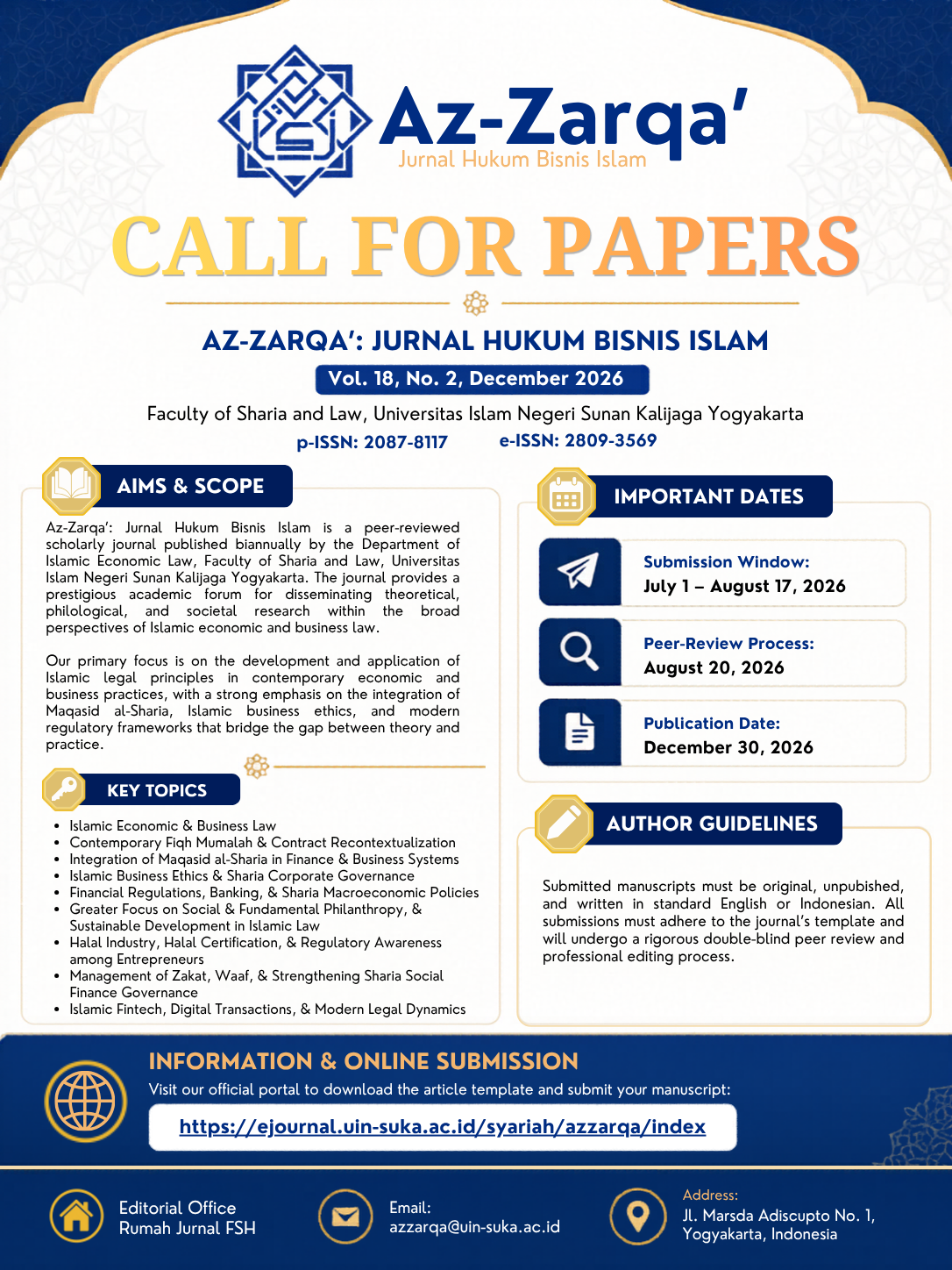
Az-Zarqa’: Jurnal Hukum Bisnis Islam is the scholarly journal of the Department of Islamic Economic Law, Faculty of Sharia and Law, Universitas Islam Negeri Sunan Kalijaga Yogyakarta. Established on December 1, 2010, the journal is published biannually (June and December).
In line with its aim to provide an academic forum for the development of Islamic Economic Law in broad perspectives, Az-Zarqa’ focuses on the development and application of Islamic legal principles in contemporary economic, business, and financial practices, with particular emphasis on the integration of Maqāṣid al-Sharīʿah, Islamic business ethics, and modern regulatory frameworks, alongside the theoretical and philosophical foundations of Islamic law that underpin them.
The journal welcomes normative-legal, conceptual, comparative, and empirical manuscripts that bridge theory and practice and offer both analytical and applied contributions to the advancement of Islamic Economic Law. All submissions undergo a rigorous selection process, double-blind peer review, and professional editing. Az-Zarqa’ is committed to publishing work of relevance to scholars, researchers, practitioners, and policymakers in the fields of Islamic law, economics, and finance.
Indexed by:



Announcements
Current Issue
Vol. 18 No. 1 (2026): Az-Zarqa'


This issue presents scholarly articles collaboratively authored by researchers from Indonesia, Malaysia, Philippines, and United States, reflecting the journal’s growing international engagement and cross-border academic collaboration in contemporary Islamic economic, business, and financial law through inclusive and interdisciplinary perspectives.