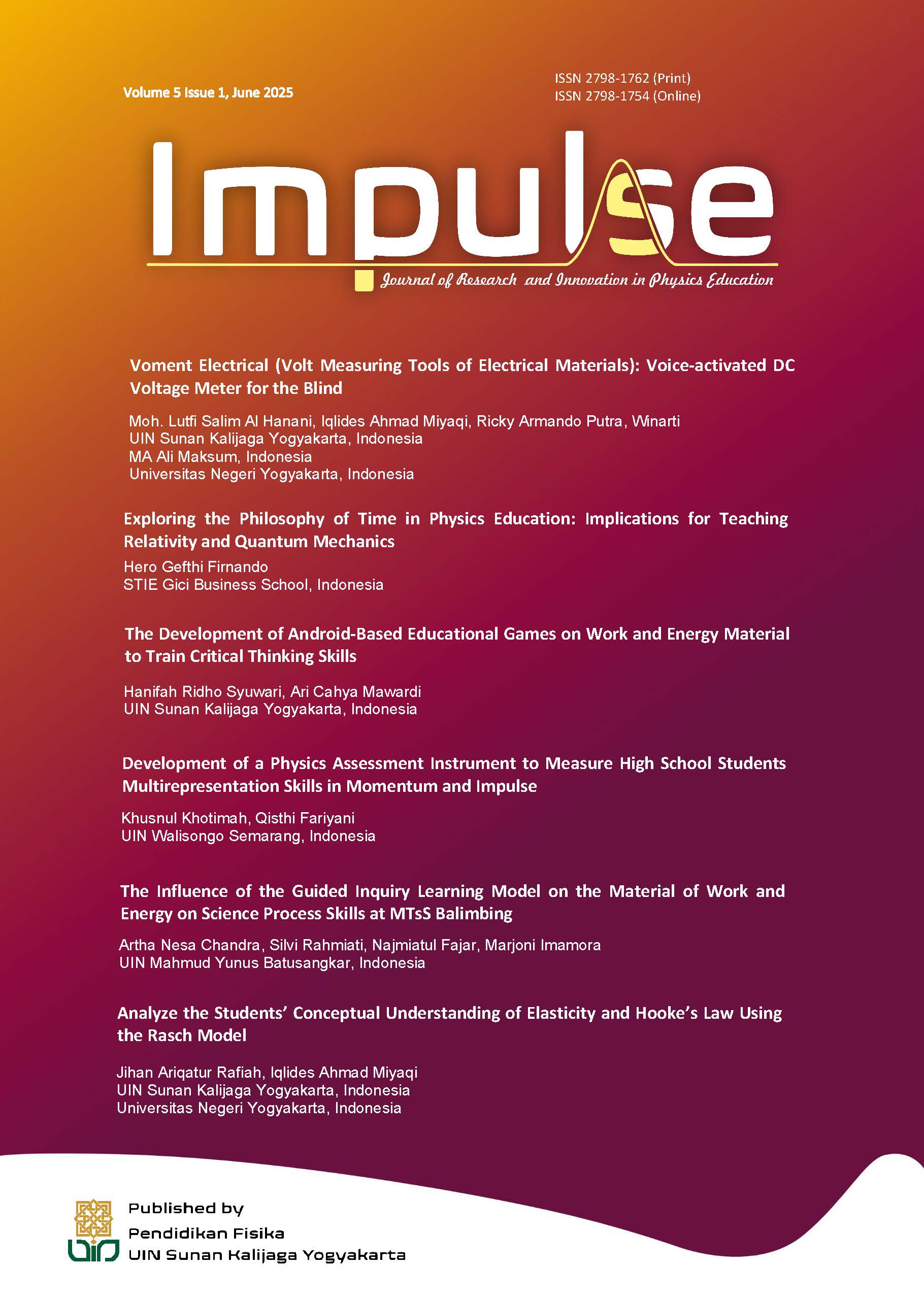
Exploring the Philosophy of Time in Physics Education: Implications for Teaching Relativity and Quantum Mechanics
DOI:
https://doi.org/10.14421/impulse.2025.51-02Keywords:
Philosophy of Time, Physics Education, Relativity, Quantum Mechanics, Teaching StrategiesAbstract
This study examines the role of the philosophy of time in physics education, with particular focus on its implications for teaching relativity and quantum mechanics. Time is a fundamental yet perplexing concept in both theories, often posing challenges for educators and learners due to its abstract and counterintuitive nature. To address this, the research explores how philosophical perspectives on time can inform and improve teaching practices. A qualitative approach was employed, consisting of a systematic literature review of both philosophy of physics and physics education research, combined with a textual and pedagogical analysis of existing teaching strategies used in relativity and quantum mechanics instruction. Sources included peer-reviewed journals, educational frameworks, and documented classroom practices. Data were organized and coded using NVivo software to identify recurring themes in how philosophical engagement with time has been integrated into teaching. The findings indicate that incorporating structured philosophical discussions—such as debates on the nature of simultaneity or the problem of temporal measurement in quantum mechanics—can clarify conceptual paradoxes and provide students with alternative interpretive frameworks. Evidence of improved comprehension was drawn from reported student reflections, documented learning outcomes, and thematic patterns in prior classroom-based studies, rather than self-reported claims alone. Furthermore, the integration of philosophy was shown to foster critical thinking, operationalized here as students’ ability to question assumptions, articulate multiple interpretations, and resolve conceptual tensions in physics discourse. The study concludes that systematically embedding the philosophy of time into the physics curriculum can significantly enhance comprehension of relativistic and quantum principles, refine teaching methodologies, and cultivate a more reflective and critical learning environment.
References
D. C. Youvan and Y. Ai, “Illuminating Intelligence: Bridging Humanity and Artificial Consciousness,” 2024, doi: 10.13140/RG.2.2.23383.89767.
P. Sun and X. Zuo, “Evolution and History of Research Philosophy.”
A. Bardon, “A Brief History of the Philosophy of Time,” Jul. 01, 2013, Oxford University Press. doi: 10.1093/acprof:oso/9780199976454.001.0001.
S. Mohammad Mousavi and M. Ghanbari, “In Philosophy, All Endeavors Are Founded. Philosophical Thought In The Narrative: Resolving Scientific Challenges,” Int. J. Hum. Contempl., vol. 1, no. 1, pp. 1–25, 2024.
J.-Y. Oh, “Understanding the various scientific theories in the history of science,” Indian J. Hist. Sci., vol. 59, no. 3, pp. 284–296, 2024, doi: 10.1007/s43539-024-00135-2.
M. J. Rodriguez, “Welt: The concept that changed physics,” J. Phys. Conf. Ser., vol. 2877, no. 1, p. 12062, 2024, doi: 10.1088/1742-6596/2877/1/012062.
S. Shamohammadi, “Basics of modern modeling and expansion of the relativity theory of time in the field of classical physics,” Appl. Water Sci., vol. 14, no. 10, pp. 1–29, 2024, doi: 10.1007/s13201-024-02263-7.
O. Freire Junior, “From the Interpretation of Quantum Mechanics to Quantum Technologies,” 2024, Oxford University Press. doi: 10.1093/acrefore/9780190871994.013.124.
B. M.T, “Limitations Of Newton’s Second Law In The Quantum Realm: A Comparative Analysis With Quantum Physics,” Educ. Adm. Theory Pract., vol. 30, no. 4, pp. 382–385, 2024, doi: 10.53555/kuey.v30i4.1684.
J. H. C. Wong, “Integrating Quantum Mechanics and the Advanced Observer Model: A New Paradigm for Reality Construction,” J. Quantum Inf. Sci., vol. 14, no. 04, pp. 158–195, 2024, doi: 10.4236/jqis.2024.144008.
A. Plotnitsky, The Principles of Quantum Theory, From Planck’s Quanta to the Higgs Boson, Springer I. Cham, 2016.
H. Reichenback, The Philosophy of space & Time, Edisi pert. New york: Dover Publication, 1957.
M. Friedman, Foundations of Space-Time Theories: Relativistic Physics and Philosophy of Science. in Princeton Legacy Library. Princeton University Press, 2014.
P. J. Mcpherson, A Phenomenological exploration of educators’ lived experiences and transitions from teacher-centered to student-centered learning. Northwest Nazarene University, 2020.
F. Besnard, “Is there a philosophy of time compatible with relativity and quantum mechanics?,” AIP Conf. Proc., vol. 1446, no. 1, pp. 437–447, Jun. 2012, doi: 10.1063/1.4728010.
F. Besnard, “Is there a philosophy of time compatible with relativity and quantum mechanics?,” AIP Conf. Proc., vol. 1446, no. June 2012, pp. 437–447, 2012, doi: 10.1063/1.4728010.
H. K. E. Stadermann and M. J. Goedhart, “Why and how teachers use nature of science in teaching quantum physics: Research on the use of an ecological teaching intervention in upper secondary schools,” Phys. Rev. Phys. Educ. Res., vol. 17, no. 2, p. 20132, 2021, doi: 10.1103/PhysRevPhysEducRes.17.020132.
P. Alstein, K. Krijtenburg-Lewerissa, and W. R. van Joolingen, “Teaching and learning special relativity theory in secondary and lower undergraduate education: A literature review,” Phys. Rev. Phys. Educ. Res., vol. 17, no. 2, p. 23101, 2021, doi: 10.1103/PhysRevPhysEducRes.17.023101.
M. Johnpaul, J. C. Mbagwu, Z. L. Abubakar, and J. O. Ozuomba, “A Review Article on Einstein Special Theory of Relativity,” Int. J. Theor. Math. Phys., vol. 2020, no. 3, pp. 65–71, 2020, doi: 10.5923/j.ijtmp.20201003.03.
P. Kos, “On the meaning of Einstein’s relativity-scientific review of and philosophical reflection on Einstein’s theory of special relativity,” Phys. Essays, vol. 27, no. 3, pp. 411–447, 2014, doi: 10.4006/0836-1398-27.3.411.
M. A. Cooper, C. J. Andrews, R. L. Holle, R. Blumenthal, and N. Navarrete Aldana, Lightning-Related Injuries and Safety, Seventh Ed., vol. 1–2. Elsevier Inc., 2016. doi: 10.1016/B978-0-323-35942-9.00005-X.
A. Ney, “The World in the Wave Function: A Metaphysics for Quantum Physics,” May 2021, Oxford University Press. doi: 10.1093/oso/9780190097714.001.0001.
G. H. Wallace, “Improving Spanish Classroom Assessment via Logistic Regression: Lessons from the Rasch Model,” J. Spanish Lang. Teach., vol. 7, no. 1, pp. 51–63, 2020, doi: 10.1080/23247797.2020.1771009.
S. Maes, “Unruh effects, Hawking Black Hole Evaporation, Quantum Corrected Larmor Formula, Numbers of Particles in Curved Spacetime: ‘Same-Same, but Just A Bit Different, 2022. https://doi.org/10.5281/zenodo.8306942
A. Driessen, “Philosophical Aspects of Time in Modern Physics,” Qeios, vol. 6, no. 11, pp. 1–19, 2024, doi: 10.32388/jmxur9.2.
M. E. Asadu and N. U. Asogwa, “Henry Bergson’s Theory of Duration: A Critical Review,” Nigerian Journal of Philosophical Studies, vol. 3, no. 2, 2024
P. Brea, “Critique of the Concept of Energy in Light of Bergson’S Philosophy of Duration,” Thaumàzein, vol. 1, no. 12, pp. 108–133, 2024.
A. Rossi, “Brain and Quantum Mechanics: the Epistemological Challenge of Neuroscience", 2024, http://dx.doi.org/10.2139/ssrn.4801540
S. Khudaikulova and S. Ruzikulov, “Quantum Mathematics And Physics: Studying Mathematical Foundations And Applications,” Medicine, pedagogy and technology: theory and practice, vol. 2, no. 12, pp. 293–295, 2024.
S. Brahmacari, “Understanding the Space-Time Continuum: A Comprehensive study on the Theory of Relativity As revealed in Vedic literature,” SSRN Electron. J., Jan. 2024, doi: 10.2139/ssrn.4802241.
J. Stephenson, “Ambient Temporalities: Rethinking Object-Oriented Time through Kant, Husserl, and Heidegger,” Open Philos., vol. 7, no. 1, 2024, doi: 10.1515/opphil-2024-0035.
K. Kinzel, “Neo-Kantian conceptualism: between scientific experience and everyday perception,” Br. J. Hist. Philos., vol. 32, no. 6, pp. 1350–1373, 2024, doi: 10.1080/09608788.2023.2237070.
F. Patras, “‘Poincaré: The Philosopher’ by Léon Brunschvicg: A Perspective,” 2024, pp. 59–88. doi: 10.1007/978-3-031-42190-7_4.
A. Simmonds, “A Study of the Legal Implications of Time Dilation in Accordance with Einstein’s Theory of Special Relativity,” Cambridge Law Rev., vol. 9, no. 1, pp. 1–27, 2024.
P. Holme and J. Saramäki, “Temporal networks,” Phys. Rep., vol. 519, no. 3, pp. 97–125, 2012, doi: 10.1016/j.physrep.2012.03.001.
M. T. Manninen, Through the Wormhole on Spacetime Surface : Early History of Topological (TGD). Holistic Science Publications, 2024. doi: 10.5281/zenodo.11218517.
D. Aerts and M. S. De Bianchi, “University of the Basque Country (UPV / EHU) A quantum mechanical analysis of time and motion in relativity theory - Análisis mecánico cuántico del tiempo y el movimiento en la teoría de la relatividad,” 2024.
A. Osgood, Motion Illustration: How to Use Animation Techniques to Make Illustrations Move. Bloomsbury Publishing, 2024.
S. E. Robbins, “Gibson and Time: The Temporal Framework of Direct Perception,” Ecol. Psychol., vol. 35, no. 1–2, pp. 31–50, Apr. 2023, doi: 10.1080/10407413.2023.2170234.
Downloads
Published
Issue
Section
License
Copyright (c) 2025 Impulse: Journal of Research and Innovation in Physics Education

This work is licensed under a Creative Commons Attribution-NonCommercial 4.0 International License.