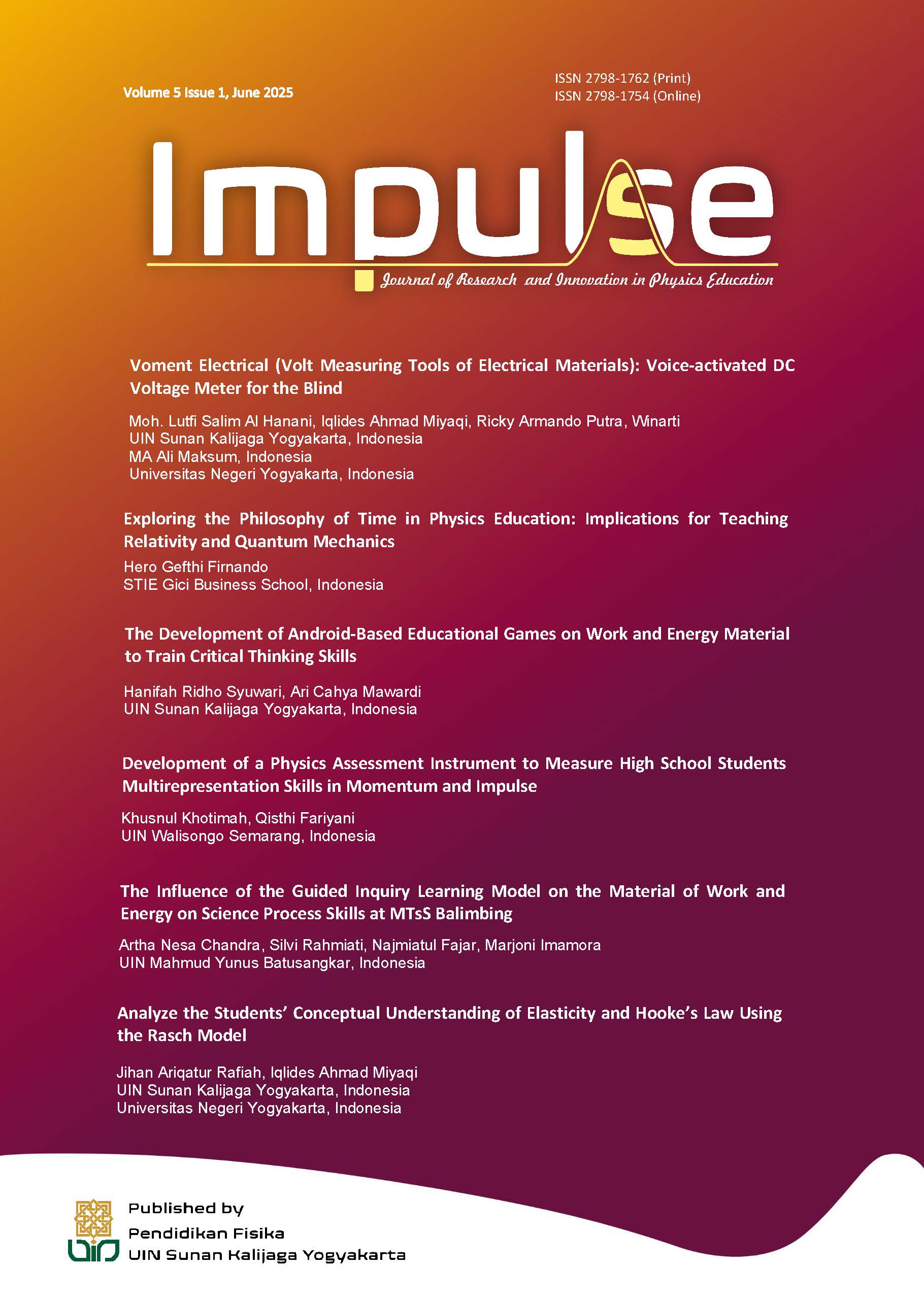
The Development of Android-Based Educational Games on Work and Energy Material to Train Critical Thinking Skills
DOI:
https://doi.org/10.14421/impulse.2025.51-03Keywords:
Critical Thinking Skill, Educational Game, Work and EnergyAbstract
Critical thinking has emerged as an essential skill for students to master in the 21st century. The topic on work and energy is difficult for students, this is due to limitation in learning media in terms of helping students, especially those based on technology. This study aimed to investigate: 1) The features of Android-based educational games designed to enhance critical thinking skills among eighth-grade students of SMP/MTS, 2) The quality of the Android-based educational games in achieving the critical thinking skills train on work and energy topic among eighth-grade students of SMP/MTS, 3) Students' perceptions of Android-based educational game on the topic of work and energy to train the critical thinking skills among eighth-grade students of SMP/MTS, 4) Enhancement of critical thinking skills among eighth-grade SMP/MTS students. This research applied a 4D model of Research and Development (R&D) that was restricted to the development stage. The research employed instruments for experts, teachers, and students. The data analysis involved V Aiken's validation, mean calculations, and N-Gain. The results of this study included: 1) the creation of learning media in the form of an educational game named GEDUSI (Energy and Work Education Games), 2) The quality of the education game developed by researchers is included in the Very Good category, 3) Student responses agree as a practical and fun learning media, 4) This game can improve students' critical thinking skills.
References
P. Partono, H. N. Wardhani, N. I. Setyowati, A. Tsalitsa, and S. N. Putri, “Strategi Meningkatkan Kompetensi 4C (Critical Thinking, Creativity, Communication, & Collaborative),” J. Penelit. Ilmu Pendidik., vol. 14, no. 1, pp. 41–52, 2021, doi: 10.21831/jpipfip.v14i1.35810.
N. Asnawi, A. Indika Seprapti, A. Haqqo, A. Lailaul Fitriyah, S. Kusairi, and P. Parno, “Pemahaman Konsep Dan Kesulitan Belajar Mahasiswa: Studi Lintas Semester Pada Materi Usaha Energi,” J. Ilm. Pendidik. Lingkung. dan Pembang., vol. 21, no. 01, pp. 18–29, 2020, doi: 10.21009/plpb.211.03.
A. Z. Ilma and H. Kuswanto, “Gravitational Acceleration: Its Determination from Gourami Jumping Motion Using Tracker Application,” Impuls. J. Res. Innov. Phys. Educ., vol. 4, no. 2, pp. 96–106, 2025, doi: 10.14421/impulse.2024.42-03.
E. Septianawati and E. Abdilah, “Kemampuan Penalaran Matematis Ditinjau dari Model Problem Based Learning dengan Contextual Teaching and Learning,” KontinuJurnal Penelit. Didakt. Mat., vol. 5, no. 2, pp. 80–87, 2021, doi: 10.30659/kontinu.5.2.80-87.
S. Damarjati and A. Miatun, “Pengembangan Game Edukasi Berbasis Android sebagai Media Pembelajaran Berorientasi pada Kemampuan Berpikir Kritis,” ANARGYA J. Ilm. Pendidik. Mat., vol. 4, no. 2, pp. 164–175, 2021, doi: 10.24176/anargya.v4i2.6442.
A. I. Seprapti, Nizami, A. Haqqo, A. L. Fitriyah, S. Kusairi, and Parno, “Pemahaman Konsep dan Kesulitan Belajar Mahasiswa: Studi Lintas Semester pada Materi Usaha Energi,” J. Ilm. Pendidik. Lingkung. dan Pembang., vol. 21, no. 01, pp. 18–29, 2020, doi: 10.21009/plpb.211.03.
A. A. Permana and I. Kartika, “Brain-Based Learning: The Impact on Student’s Higher Order Thinking Skills and Motivation,” J. Ilm. Pendidik. Fis. Al-Biruni, vol. 10, no. 1, pp. 47–58, 2021, doi: 10.24042/jipfalbiruni.v10i1.6908.
L. Yuliati, R. Fauziah, and A. Hidayat, “Student’s Critical Thinking Skills in Authentic Problem based Learning,” in Journal of Physics: Conference Series, Bandung: IOP Publishing, 2018, pp. 1–6. doi: 10.1088/1742-6596/1013/1/012025.
N. Jalinus et al., “Developing Blended Learning Model in Vocational Education Based On 21st Century Integrated Learning and Industrial Revolution 4.0,” Turkish J. Comput. Math. Educ., vol. 12, no. 9, pp. 1276–1291, 2021.
I. Af’idah and R. Kustijono, “Penggunaan Physics Education Game untuk Melatihkan Keterampilan Berpikir Kritis Siswa SMA,” IPF Inov. Pendidik. Fis., vol. 9, no. 1, pp. 271–275, 2020.
S. D. Novidya and R. Kustijono, “Game Applied Physics untuk Melatihkan Keterampilan Berpikir Kritis Siswa SMA,” IPF Inov. Pendidik. Fis., vol. 09, no. 02, pp. 242–246, 2020.
T. S. Qodr, “Pengembangan Mobile Game-based Learning pada Mata Pelajaran Sosiologi untuk Meningkatkan Keterampilan Berpikir Kritis pada Siswa SMA di Klaten,” UNS, 2022.
O. P. Aryaningtyas, “Pengembangan Media Game Edukasi Matematika Materi Penjumlahan untuk Kelas I SD/MI,” UIN Sunan Kalijaga Yogyakarta, 2023.
Sugiyono, Metodologi Penelitian Kuantitatif, Kualitatif dan R & D. 2020.
F. A. Zahwa and I. Syafi’i, “Pemilihan Pengembangan Media Pembelajaran Berbasis Teknologi Informasi,” Equilib. J. Penelit. Pendidik. dan Ekon., vol. 19, no. 01, pp. 61–78, 2022, doi: 10.25134/equi.v19i01.3963.
M. Fishburne, “Amanda,” Who We Are Now, vol. VIII, no. 1, pp. 210–213, 2024, doi: 10.5149/northcarolina/9781469671239.003.0098.
D. Sulisworo, “Blended Learning: Improving Student’s Motivation in English Teaching Learning Process,” Int. J. Lang. Educ., vol. 1, pp. 163–170, Mar. 2018, doi: 10.18298/ijlet.2434.
Downloads
Published
Issue
Section
License
Copyright (c) 2025 Impulse: Journal of Research and Innovation in Physics Education

This work is licensed under a Creative Commons Attribution-NonCommercial 4.0 International License.