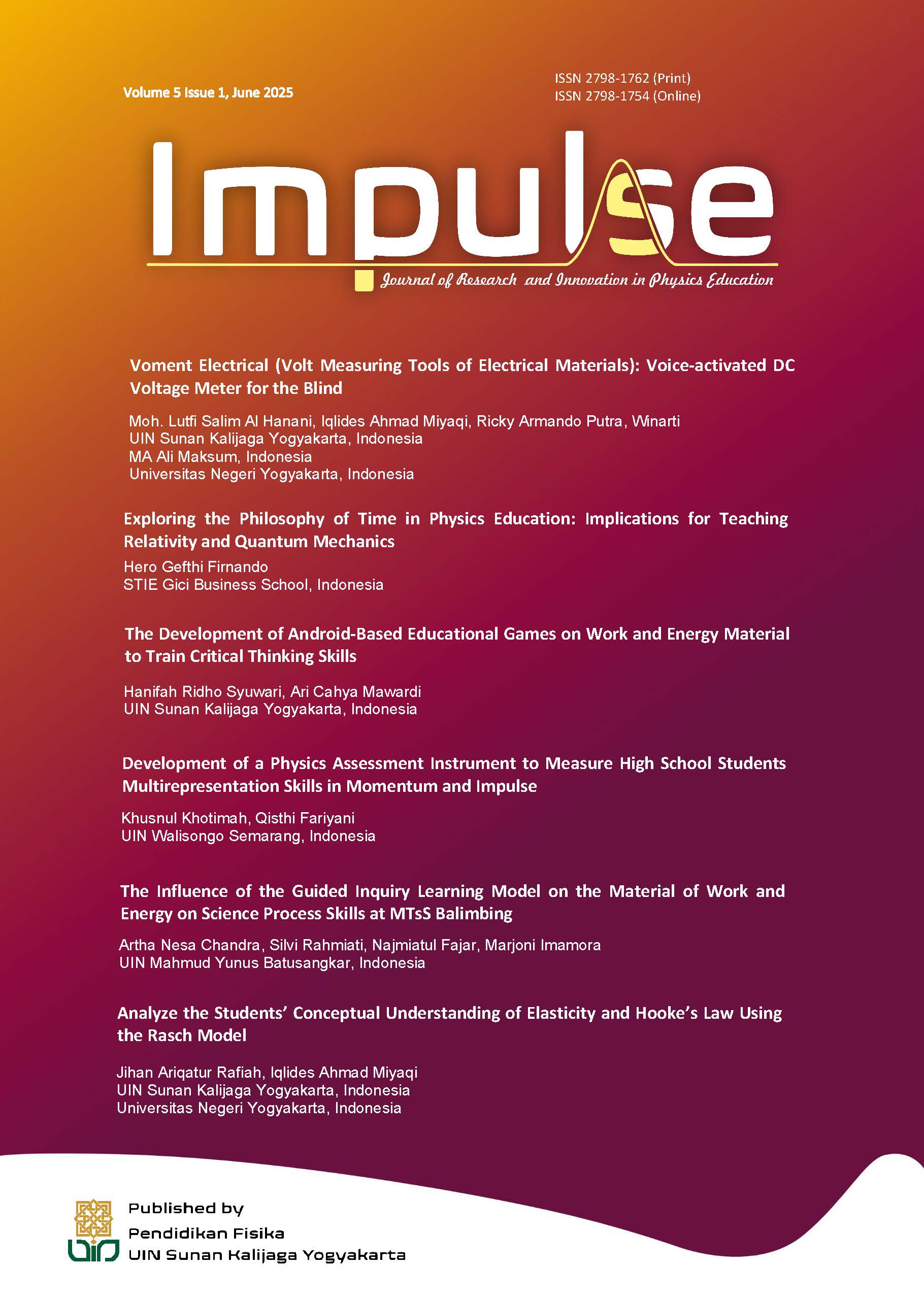
The Influence of the Guided Inquiry Learning Model on the Material of Work and Energy on Science Process Skills at MTsS Balimbing
DOI:
https://doi.org/10.14421/impulse.2025.51-05Keywords:
Guided Inquiry Learning Model, Science Process Skills (SPS)Abstract
The purpose of this study was to see the effect of guided inquiry learning model on students' science process skills on work and energy. The type of research is Quasi Experimental research and the research design used is Posttest Only Control Group Design. The sample consists of 2 classes, the experimental class is class VIII 1 and the control class is class VIII 2 consisting of 37 students. The sampling technique used is simple random sampling. The instrument used in the study was a final test of 20 questions. The results of the science process skills data analysis showed an average score of science process skills test of 70.43%, while students in the control class obtained an average score of science process skills test of 60.53%. The results of the data test were analyzed using the t-test formula, which showed that t (count) > t (table) was 2.98 > 2.02. This shows that the use of guided inquiry learning model on work and energy material has an effect on the science process skills of class VIII students at MTsS Balimbing.
References
Trianto, Mendesain Model Pembelajaran Inovatif-Progresif. Jakarta: Kencana, 2010.
M. Eka, “Hakikat Fisika dan Keterampilan Proses Sains,” J. Filsafat Indones., vol. 3, no. 3, pp. 72–80, 2020.
D. Darmaji, D. A. Kurniawan, H. Parasdila, and I. Irdianti, “Deskripsi Keterampilan Proses Sains Mahasiswa pada Materi Termodinamika,” Berk. Ilm. Pendidik. Fis., vol. 6, no. 3, pp. 345–353, 2018, doi: 10.20527/bipf.v6i3.5290.
Y. F. Amalia, Z. Zainuddin, and M. Misbah, “Pengembangan Bahan Ajar IPA Fisika Berorientasi Keterampilan Generik Sains Menggunakan Model Pembelajaran Inkuiri Terbimbing DI SMP Negeri 13 Banjarmasin,” Berk. Ilm. Pendidik. Fis., vol. 4, no. 3, pp. 183–191, 2016, doi: 10.20527/bipf.v4i3.1005.
H. E. Abungu, M. I. O. Okere, and S. W. Wachanga, “The Effect of Science Process Skills Teaching Approach on Secondary School Students’ Achievement in Chemistry in Nyando District, Kenya,” J. Educ. Soc. Res., vol. 4, no. 6, pp. 359–372, 2014, doi: 10.5901/jesr.2014.v4n6p359.
G. U. Jack, “The Influence of Identified Student and School Variables on Students ’ Science Process Skills Acquisition,” J. Educ. Pract., vol. 4, no. 5, pp. 16–23, 2013.
A. Kadarwati and I. Malawi, Pembelajaran Tematik (Konsep dan Aplikasi). Magetan: AE Media Grafika, 2017.
Trianto and F. Yustianti, Model Pembelajaran Terpadu: Konsep, Strategi dan Implementasinya dalam Kurikulum Tingkat Satuan Pendidikan (KTSP). Jakarta: Bumi Aksara, 2013.
R. O. Ongowo and F. C. Indoshi, “Science Process Skills in the Kenya Certificate of Secondary Education Biology Practical Examinations,” Creat. Educ., vol. 04, no. 11, pp. 713–717, 2013, doi: 10.4236/ce.2013.411101.
A. Purba et al., Strategi Pembelajaran (Suatu Pengantar). Medan: Yayasan Kita Menulis, 2022.
Sugiyono, Metode penelitian pendidikan. Bandung: Alfabeta, 2011.
Sugiyono, Metode Penelitian Pendidikan. Bandung: Alfabeta, 2019.
W. Susanti, “Pengaruh Model Pembelajaran Inkuiri Terbimbing terhadap Keterampilan Proses Sains Siswa pada Materi Laju Reaksi (Kuasi Eksperimen di SMA Negeri 4 Kabupaten Tangerang),” UIN Syarif Hidayatullah Jakarta, 2014.
S. Hidayatullah and R. Wulan, “Meta-analysis of the influence of 21st century high school students’ skills in learning physics using a guided inquiry model,” J. Phys. Conf. Ser., vol. 2309, no. 1, p. 12057, 2022, doi: 10.1088/1742-6596/2309/1/012057.
I. A. P. N. Warmadewi, “Penerapan Model Pembelajaran Inkuiri Terbimbing Berbasis Literasi Sains Dalam Pembelajaran IPA,” J. Pendidik. MIPA, vol. 12, no. 2, pp. 325–331, 2022, doi: 10.37630/jpm.v12i2.600.
Downloads
Published
Issue
Section
License
Copyright (c) 2025 Impulse: Journal of Research and Innovation in Physics Education

This work is licensed under a Creative Commons Attribution-NonCommercial 4.0 International License.