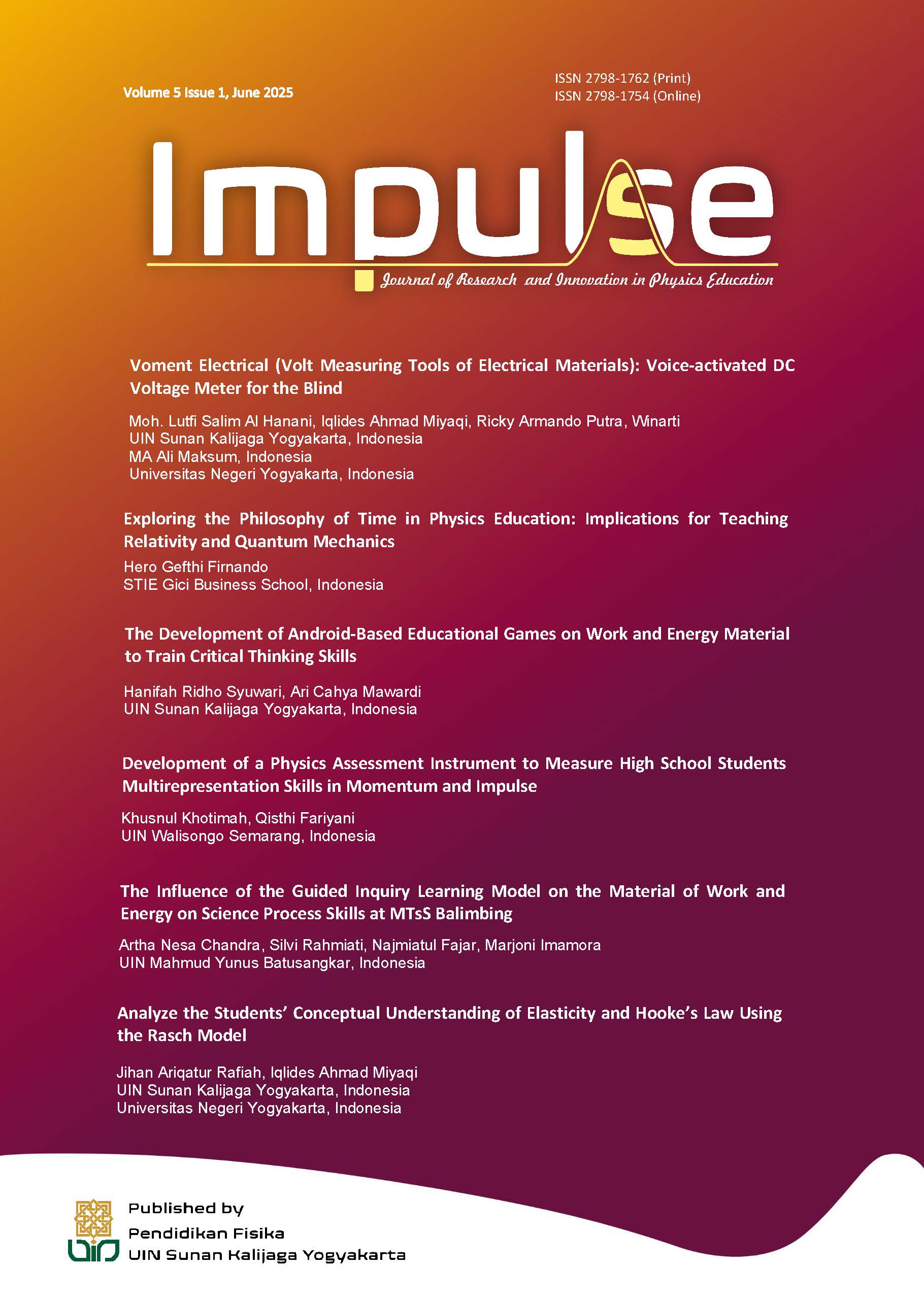
Analyze the Students’ Conceptual Understanding of Elasticity and Hooke’s Law Using the Rasch Model
DOI:
https://doi.org/10.14421/impulse.2025.51-06Keywords:
Conceptual Understanding, Elasticity and Hooke’s Law, Multiple Choice Questions (MCQs), Rasch ModelAbstract
This study investigates students’ conceptual understanding of Elasticity and Hooke’s Law by employing the Rasch measurement model. Conceptual understanding in physics is essential for enabling learners to apply principles across contexts and develop critical thinking skills. The 20 items multiple-choice test was developed and validated to assess mastery of elasticity-related concepts. The approach in this study was quantitative that conducted in Yogyakarta, Indonesia, involving 56 senior high students who had completed lessons on the relevant topic. The Rasch model was applied using the Ministeps software to analyze item difficulty and student ability. The Wright map and fit statistics indicated that most students had low to moderate levels.
References
P. Phanphech, T. Tanitteerapan, and E. Murphy, “Explaining and Enacting for Conceptual Understanding in Secondary School Physics,” Issues Educ. Res., vol. 29, no. 1, pp. 180–204, 2019.
H. J. Banda and J. Nzabahimana, “Effect of Integrating Physics Education Technology Simulations on Students’ Conceptual Understanding in Physics: A Review of Literature,” Phys. Rev. Phys. Educ. Res., vol. 17, no. 2, pp. 023108-1-023108–18, 2021, doi: 10.1103/PhysRevPhysEducRes.17.023108.
G. H. Wallace, “Improving Spanish Classroom Assessment via Logistic Regression: Lessons from the Rasch Model,” J. Spanish Lang. Teach., vol. 7, no. 1, pp. 51–63, 2020, doi: 10.1080/23247797.2020.1771009.
W. L. Nurjanah, I. M. Sari, and D. Saepuzaman, “Analisis Pemahaman Konsep Peserta Didik Pada Topik Perambatan Kalor Menggunakan Rasch Model,” Didakt. J. Kependidikan, vol. 13, no. 2, pp. 1361–1374, 2024, doi: 10.58230/27454312.442.
B. Sumintono, “Aplikasi Pemodelan Rasch pada Asesmen Pendidikan: Implementasi Penilaian Formatif (Assessment for Learning),” 2016, Institut Teknologi Sepuluh November, Surabaya. [Online]. Available: http://eprints.um.edu.my/15876/1/ITS_rasch_model_asesment_for_learning.pdf
R. M. A. Al Ali and R. T. Shehab, “Psychometric Properties of Social Perception of Mathematics: Rasch Model Analysis,” Int. Educ. Stud., vol. 13, no. 12, pp. 102–110, 2020, doi: 10.5539/ies.v13n12p102.
J. D. Bransford, A. L. Brown, and R. R. Cocking, How People Learn: Brain, Mind, Experience, and School: Expanded Edition. Washington, DC: National Academy Press, 2000.
D. Hestenes, M. Wells, and G. Swackhamer, “Force Concept Inventory,” Phys. Teach., vol. 30, pp. 141–158, 1992, doi: 10.1119/1.2343497.
Z. Zacharia and O. R. Anderson, “The Effects of an Interactive Computer-based Simulation Prior to Performing a Laboratory Inquiry-based Experiment on Students’ Conceptual Understanding of Physics,” Am. J. Phys., vol. 71, no. 6, pp. 618–629, Jun. 2003, doi: 10.1119/1.1566427.
T. M. Haladyna, S. M. Downing, and M. C. Rodriguez, “A Review of Multiple-Choice Item-Writing Guidelines for Classroom Assessment,” Appl. Meas. Educ., vol. 15, no. 3, pp. 309–333, Jul. 2002, doi: 10.1207/S15324818AME1503_5.
M. Tarrant and J. Ware, “A Comparison of the Psychometric Properties of Three- and Four-option Multiple-choice Questions in Nursing Assessments,” Nurse Educ. Today, vol. 30, no. 6, pp. 539–543, 2010, doi: 10.1016/j.nedt.2009.11.002.
W. J. Boone, J. R. Staver, and M. S. Yale, Rasch Analysis in the Human Sciences. Springer, 2014.
B. Sumintono and W. Widhiarso, Aplikasi Pemodelan Rasch pada Assessment Pendidikan. Cimahi: Trim Komunikata, 2015.
Z. Arsiah et al., “Profil Satuan Pendidikan dengan Capaian AKM Tinggi pada Jenjang SMA/SMK/MA/Sederajat,” Jakarta, 2024.
H. Kurli, N. Haliqah, and A. Anekawati, “Analisis Kemampuan Kognitif Siswa pada Mata Pelajaran IPA SMP Menggunakan Rasch Model,” in Prosiding Webinar Nasional Penelitian dan Pengabdian kepada Masyarakat, Sumenep: Universitas Wiraraja, 2021.
T. G. Bond and C. M. Fox, Applying the Rasch model: Fundamental Measurement in the Human Sciences. Routledge/Taylor & Francis Group, 2015.
Downloads
Published
Issue
Section
License
Copyright (c) 2025 Impulse: Journal of Research and Innovation in Physics Education

This work is licensed under a Creative Commons Attribution-NonCommercial 4.0 International License.