WHEN MACHINES BECOME PREACHERS
The Emergence of AI-Based Religious Influencers And Synthetic Da'wah Content

Downloads
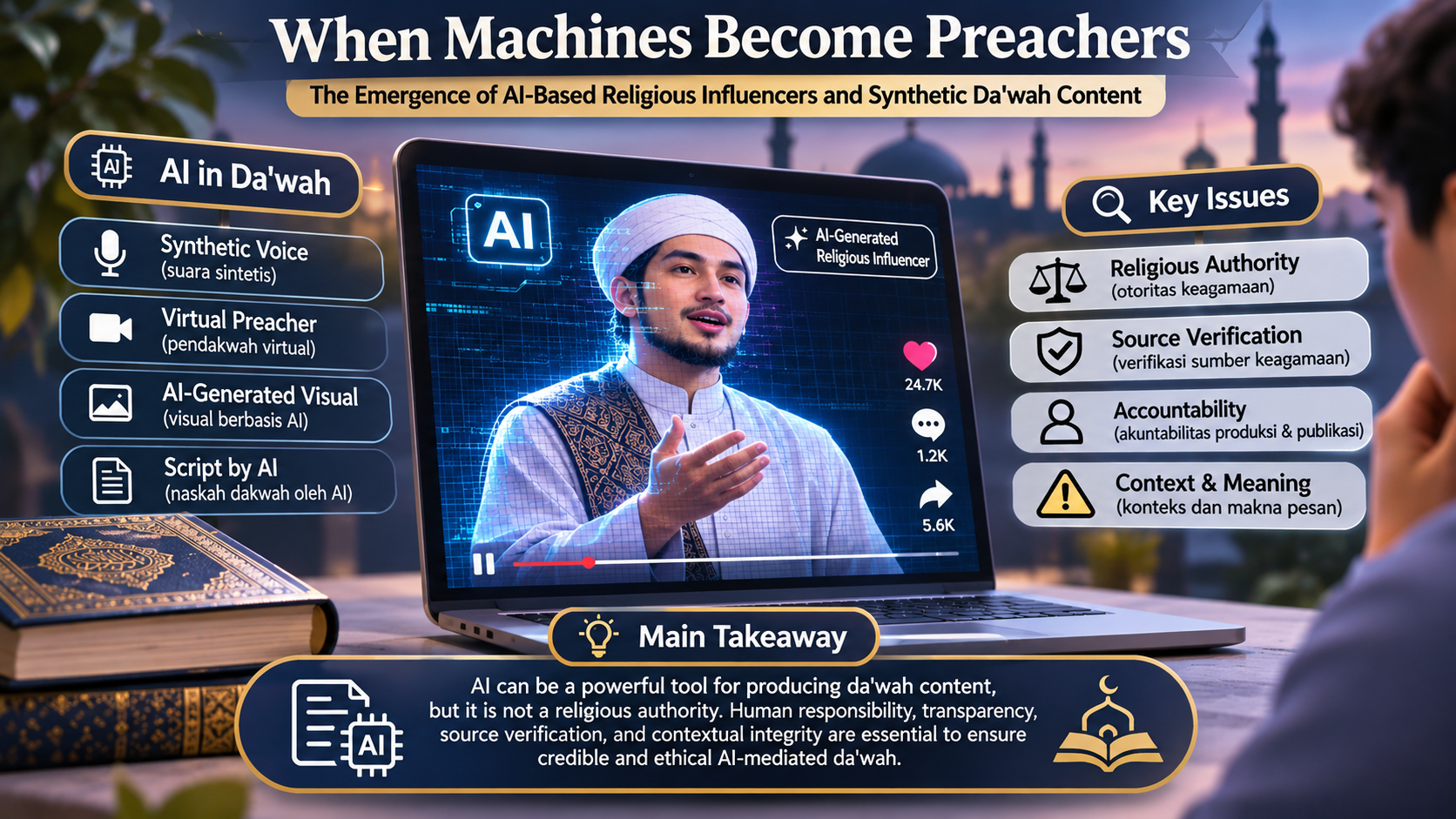
The emergence of AI-based religious influencers and synthetic da'wah content raises critical questions about religious authority, authenticity, and accountability in digital Islamic communication. This article examines how virtual preacher figures are constructed, how synthetic da'wah content is produced and circulated, and how its religious legitimacy can be assessed. Adopting a qualitative approach through documentary analysis and conceptual review, the study draws on academic literature and publicly available policies governing AI-generated content. The analysis reveals that synthetic preacher figures can simulate the appearance of religious authority without possessing the scholarly qualifications, interpretive competence, or moral responsibility traditionally associated with religious communication. It further identifies limitations in platform-based AI disclosure, particularly its inability to establish the validity of religious claims or clarify human responsibility. The article proposes a governance framework based on four principles: transparency, religious verification, human accountability, and contextual integrity. These principles position AI as a supporting production technology rather than an autonomous religious authority.
Kemunculan influencer keagamaan berbasis kecerdasan buatan (AI) dan konten dakwah sintetis memunculkan persoalan kritis mengenai otoritas keagamaan, autentisitas, dan akuntabilitas dalam komunikasi Islam digital. Artikel ini mengkaji bagaimana figur pendakwah virtual dikonstruksi, bagaimana konten dakwah sintetis diproduksi dan didistribusikan, serta bagaimana legitimasi keagamaannya dapat dinilai. Dengan pendekatan kualitatif melalui analisis dokumenter dan kajian konseptual, penelitian ini menggunakan literatur akademik serta kebijakan publik mengenai konten yang dihasilkan AI. Analisis menunjukkan bahwa figur pendakwah sintetis dapat menyimulasikan penampilan otoritas keagamaan tanpa memiliki kualifikasi keilmuan, kompetensi interpretatif, maupun tanggung jawab moral sebagaimana dituntut dalam komunikasi keagamaan. Artikel ini juga mengidentifikasi keterbatasan pelabelan AI oleh platform digital karena tidak menjamin validitas pesan keagamaan maupun kejelasan tanggung jawab manusia. Sebagai respons, artikel ini mengusulkan kerangka tata kelola berdasarkan empat prinsip: transparansi, verifikasi keagamaan, akuntabilitas manusia, dan integritas kontekstual.
Ahmad, Hishomudin, and Norfarhana Ahmad Ghafar. 2026. “Who Speaks When Machines Read Scripture: Boundary-Making and Interpretive Authority in AI-Mediated Religious Knowledge.” AI and Ethics 6 (5). https://doi.org/10.1007/s43681-026-01254-5.
Alshaar, Amaal Mohammad Khalil. 2025. “Knowledge Lineage from Isnad to AI: Reframing Authorship and Responsibility in the Generative AI Era.” International Journal of Academic Research in Business and Social Sciences 15 (9). https://doi.org/10.6007/ijarbss/v15-i9/26451.
Anim, Sarbini, Nanda Khairiyah, Ibnu Hasan Muchtar, and Jakaria Jakaria. 2026. “Artificial Intelligence and the Crisis of Religious Authority: A Conceptual Review of Islamic Discourse in the Age of Machine Mediation.” RSF Conference Series: Business, Management and Social Sciences 6: 77–84. https://doi.org/10.31098/bmss.v6i1.1095.
Arifin, Firdaus, Deni Fadly, Habibul Akhiar, Damarkunsi Majasius, and Sri Rahmadhani. 2025. “Digital Behaviorism among Muslim Communities on Social Media from the Perspective of Islamic Law.” Hakamain Journal of Sharia and Law Studies 4 (1): 89–102. https://doi.org/10.57255/hakamain.v4i1.1360.
Askaraliev, Giyosiddin, and Gayrat Utayev. 2026. “Artificial Intelligence and Religious Ethics: Evaluating Reliance on Islamic Chatbots for Spiritual Guidance.” American Journal of Social Sciences and Humanity Research 6 (3): 20–26. https://doi.org/10.37547/ajsshr/volume06issue03-06.
Atallah, Fouad Ahmed. 2026. “Digital Mediation and Fatwa Authority in Contemporary Islam: A Critical Islamic Legal and Media-Theoretical Framework.” Religions 17 (3): 350. https://doi.org/10.3390/rel17030350.
Baidawi, Baidawi. 2025. “Shaping Virtual Religious Authority: The Power of Digital Media on Micro-Celebrity Da’i.” Journal of Asian Wisdom and Islamic Behavior 3 (1). https://doi.org/10.59371/jawab.v3i1.93.
Barrett, Clark, Brad Boyd, Elie Bursztein, Nicholas Carlini, Brad Chen, Jihye Choi, Amrita Roy Chowdhury, et al. 2023. “Identifying and Mitigating the Security Risks of Generative AI.” Foundations and Trends in Privacy and Security 6 (1): 1–52. https://doi.org/10.1561/3300000041.
Bisconti, Piercosma, Andrew McIntyre, and Federica Russo. 2024. “Synthetic Socio-Technical Systems: Poiêsis as Meaning Making.” Philosophy & Technology 37 (3). https://doi.org/10.1007/s13347-024-00778-0.
Boediman, Eko. 2026. “Hybrid Communication in the Halal Lifestyle Economy: The Impact of Generative AI on Communicative Practices among Digital Entrepreneurs.” HUMAN Journal of Social Humanities and Science 3 (2): 67–78. https://doi.org/10.58738/human.v3i2.1239.
Dermawan, Herman. 2026. “Dakwah di Era Algoritma: Dialektika Etika dan Strategi Adaptasi Komunikasi Penyiaran Islam Berbasis Artificial Intelligence.” Ikhbar: Jurnal Ilmu Dakwah dan Komunikasi 1 (2): 112–23. https://doi.org/10.65823/ikhbar.11i2.15.
Gazit, Lior. 2026. “From Kafka to the Rabbi-Machine.” AI and Ethics 6 (4). https://doi.org/10.1007/s43681-026-01245-6.
Giffari, Haekal Adha Al, and Andy Dermawan. 2025. “AI vs. Human-Led Da’wah: A Comparative Rhetorical Analysis of Islamic Preaching in the Digital Age.” DINIKA: Academic Journal of Islamic Studies 10 (1): 107–30. https://doi.org/10.22515/dinika.v10i1.11374.
Ja’far, Suhermanto, Haqqul Yaqin, Iffah Iffah, Hodri Hodri, and Sanuri Sanuri. 2026. “Digital Fiqh and Maqāṣid al-Sharīʿah in the Onlife Condition.” SAMARAH: Jurnal Hukum Keluarga dan Hukum Islam 10 (1): 550–71. https://doi.org/10.22373/sjhk.v10.i1.31868.
Le, Khanh Bao Quang, Hina Khan, Fangfang Li, and Werner H. Kunz. 2026. “More Than Saying ‘It’s AI’: How Role Disclosure Transparency in AI-Generated Ads Influences Persuasion.” Psychology & Marketing 43 (10): 2532–51. https://doi.org/10.1002/mar.70175.
Lim, Francis Khek Gee. 2026. “AI and Generative Charisma in Religious Practices.” Religions 17 (5): 549. https://doi.org/10.3390/rel17050549.
Maulana, Abdullah Muslich Rizal, Farhah Farhah, Fadhillah Rachmawati, and Annisa Syifa Mulya. 2026. “From Digital Religion to Digital Islam.” Al-Ahkam: Jurnal Ilmu Syari’ah dan Hukum 11 (1): 3–26. https://doi.org/10.22515/alahkam.v11i1.11066.
McGonigle, Ian. 2026. “Synthetic Spirituality: AI Is Reshaping Religion.” Humanities and Social Sciences Communications 13 (1). https://doi.org/10.1057/s41599-026-08746-z.
Mutowwah, Aflakah. 2026. “Gen Z Brain Rot: Implications for Digital Da’wah Communication Practices.” JEET: Journal of English Education and Technology. https://doi.org/10.59689/jeet.v6i04.206.
Naidoo, Gedala Mulliah, and Angelo Nicolaides. 2025. “Prospects and Challenges in Artificial Intelligence Use and the Christian Faith: Augustinian and Other Considerations.” Pharos Journal of Theology. https://doi.org/10.46222/pharosjot.106.4032.
Natale, Simone, and Leah Henrickson. 2024. “The Lovelace Effect: Perceptions of Creativity in Machines.” New Media & Society 26 (4): 1909–26. https://doi.org/10.1177/14614448221077278.
Neonnub, Patricius, and Oktovianus Yuda Pramana. 2025. “Religious Policy in the Age of AI: A Personalist Inquiry into Moral Praxis and Digital Transformation.” Journal of Religious Policy 4 (2). https://doi.org/10.31330/repo.v4i2.114.
Qulyubi, M. Mujib, Saiful Bahri, Hayaturrohman Hayaturrohman, and Fatkhu Yasik. 2026. “Negotiating Artificial Intelligence in Contemporary Pesantren: Knowledge, Religious Authority, and Islamic Educational Traditions.” Munaddhomah: Jurnal Manajemen Pendidikan Islam 7 (3): 774–94. https://doi.org/10.31538/munaddhomah.v7i3.3291.
Rois, Choirur, and Gholamreza Yazdani. 2026. “Digital Schism: The Reconstruction of Religious Authority and the Emergence of Islamic Knowledge Elite in the AI Era.” Surau: Journal of Islamic Studies 2 (1): 96–118. https://doi.org/10.63919/surau.v2i1.65.
Saifulloh, Moh, and Samsuriyanto Samsuriyanto. 2026. “From Isnad to Algorithm: A Hybridization Model of Nahdlatul Ulama and Muhammadiyah’s Communication Strategies for Institutionalizing AI Ethics in Gen-Z Da’wah.” Suhuf 38 (1): 197–210. https://doi.org/10.23917/suhuf.v38i1.16282.
Sakinah, Hijriatu, Arsy Shakila Putri, and Ainur Rofiq. 2025. “Islamic Ethical Analysis of Deepfakes and Religious Image Manipulation.” Jurnal Lentera Insani, 141–56. https://doi.org/10.65586/jli.v1i2.28.
Saputra, Agung, and Erni Asneli Asbi. 2025. “Islam, Big Data, and Digital Ethics: Challenges in Religious Life in the Digital Age.” Pharos Journal of Theology. https://doi.org/10.46222/pharosjot.106.4022.
Suyono, Indi Aunullah, Moh. Nafi’ Alisha, Miftachul Huda, and Halimatus Sa’diyah. 2026. “Reconstructing Epistemic Authority: A Post-Human Pedagogical Framework for Artificial Intelligence in Islamic Education.” Educazione 4 (1): 168–79. https://doi.org/10.61987/educazione.v4i1.2400.
Syarifuddin, Ahmad Ihsan. 2026. “From Sanad to Algorithms: The Transformation of Islamic Authority and the Reconstruction of Nusantara Islamic Epistemology in the Digital Age.” Al Ghazali 6 (2): 467–88. https://doi.org/10.69900/ag.v6i2.577.
Tarwiyyah, Hanik Lailatut. 2025. “Kiai-AI: Renegotiating Religious Authority in the Digital Age.” Journal of Islamic Thought and Philosophy 4 (1): 106–26. https://doi.org/10.15642/jitp.2025.4.1.106-126.
Umar, Ahmad, Abdul Haqqi, Faisal Rojihisawal, Muhammad Dzul Fitrah AR, Deshinta A Dewi, and Abdulkareem Adnan. 2025. “Artificial Intelligence and the Ethics of Tafsir: Integrating Digital Technologies and Islamic Humanities in Automating Interpretative Processes.” Journal of Educational Technology and Learning Creativity 3 (2): 324–47. https://doi.org/10.37251/jetlc.v3i2.2496.
Umar, Saipul, Siti Inayatulloh, Dewi Afriani Faradilah, and Ahmad S. Moussalli. 2026. “The Transformation of Religious Authority among Muslims amid Digital Technological Development: A Systematic Review.” KARIMIYAH: Journal of Islamic Literature and Muslim Society 5 (2): 141–52. https://doi.org/10.59623/xbs9wa61.
Wang, Qinhui, Chenzhang Bao, Dursun Delen, and Emre Okçular. 2026. “Understanding the Impact of AI Label Disclosure on Engagement with Deepfake Videos.” In Proceedings of the 59th Hawaii International Conference on System Sciences. https://doi.org/10.24251/hicss.2026.352.
Copyright (c) 2026 Alfri Ultrias Ratri, Muhammad Ulinuha, Azalea

This work is licensed under a Creative Commons Attribution-NonCommercial 4.0 International License.
Authors who publish with this journal agree to the following terms:
- Authors retain copyright and grant the journal right of first publication with the work simultaneously licensed under a Creative Commons Attribution License that allows others to share the work with an acknowledgement of the work's authorship and initial publication in this journal.
- Authors are able to enter into separate, additional contractual arrangements for the non-exclusive distribution of the journal's published version of the work (e.g., post it to an institutional repository or publish it in a book), with an acknowledgement of its initial publication in this journal.
- Authors are permitted and encouraged to post their work online (e.g., in institutional repositories or on their website) prior to and during the submission process, as it can lead to productive exchanges, as well as earlier and greater citation of published work (See The Effect of Open Access).