DA'WAH, POPULAR CULTURE, AND MUSLIM IDENTITY
How Urban Communities Negotiate Religious Modernity

Downloads
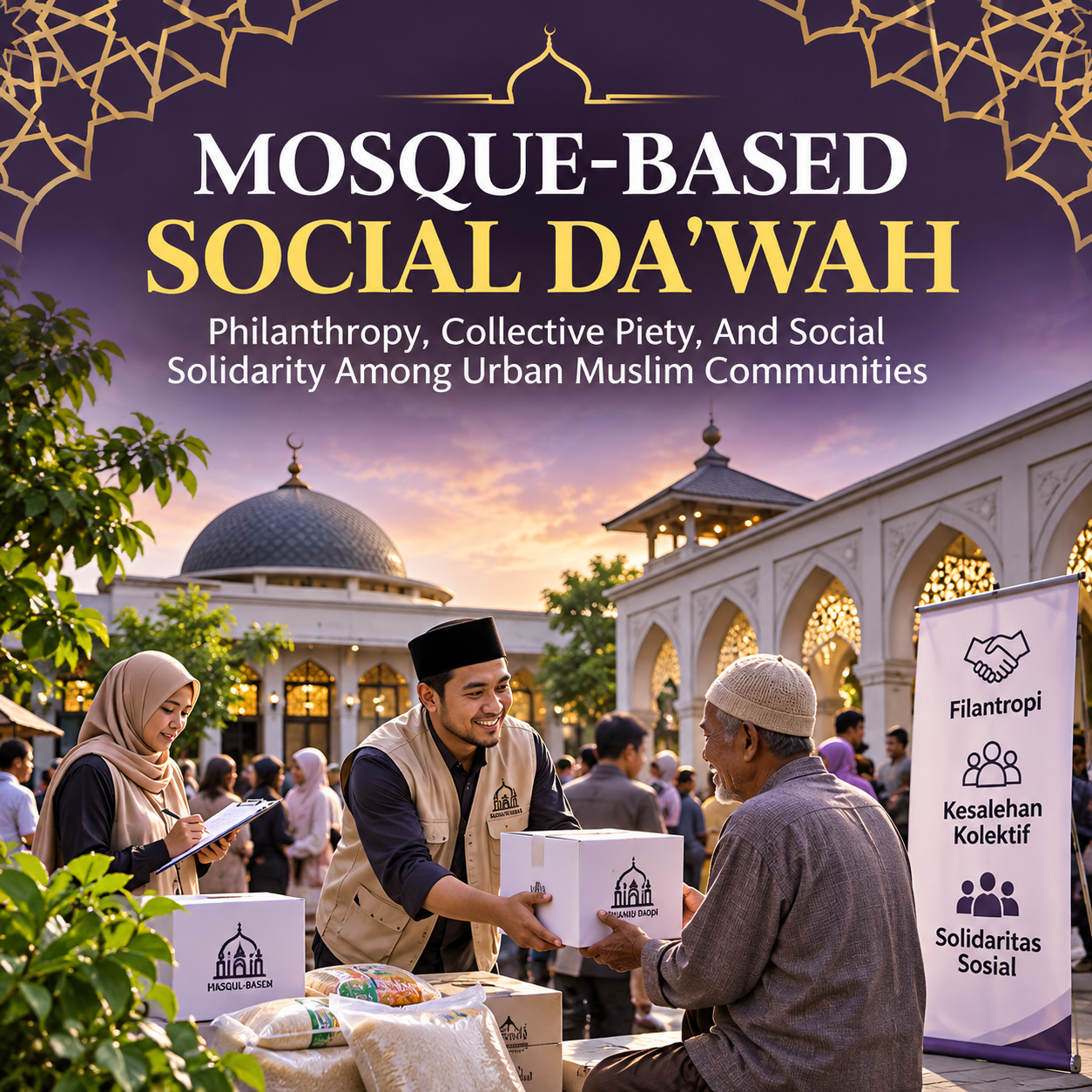
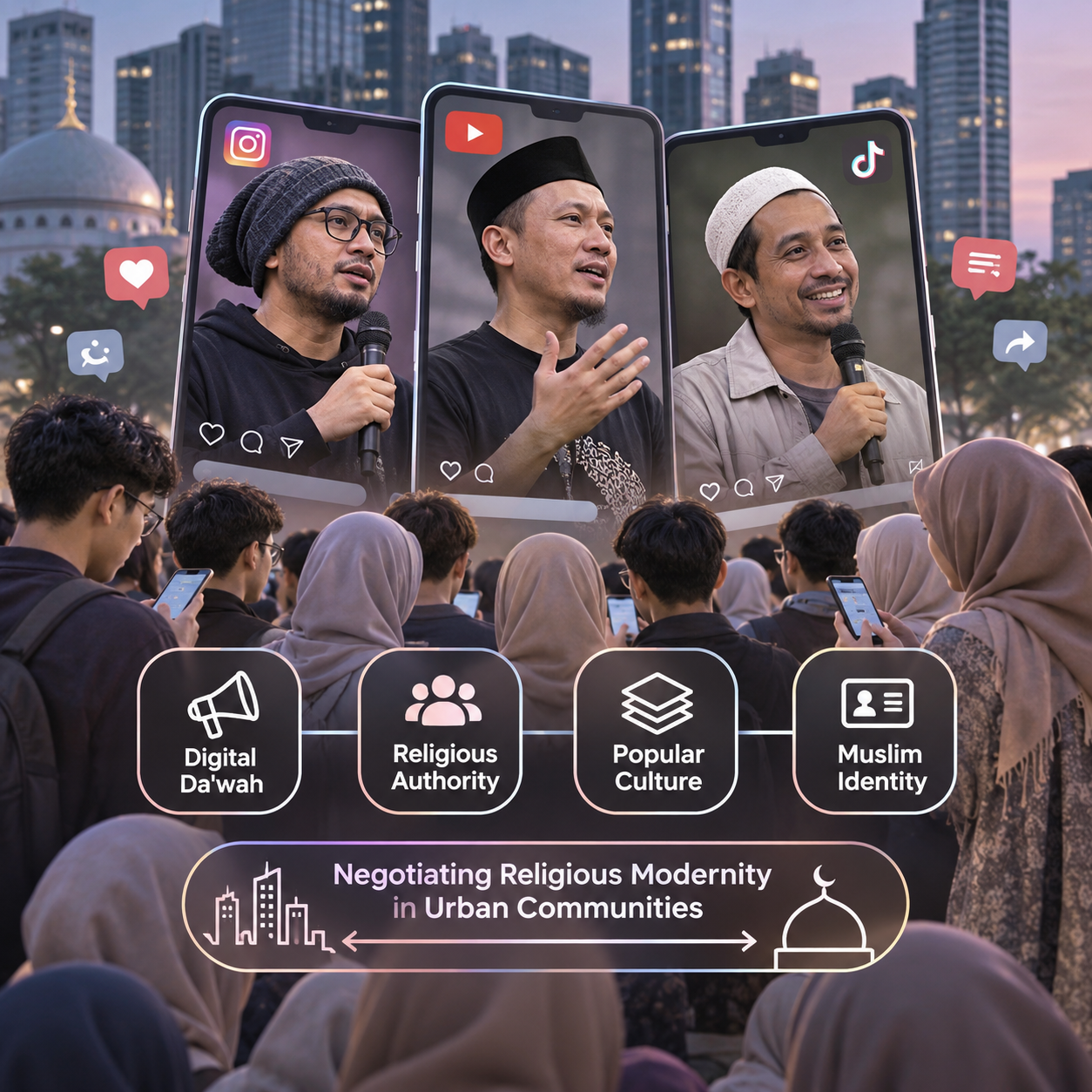
Social media has reshaped Islamic preaching (da'wah) into a cultural practice in which religious messages circulate through platform-specific performances and audience interaction. This article examines how popular preachers and their digital audiences negotiate Muslim identity and religious modernity in Indonesia. It adopts a qualitative digital-ethnographic perspective and a comparative documentary approach to publicly accessible materials associated with Hanan Attaki, Felix Siauw, and Habib Husein Ja'far Al-Hadar, within the observation framework of January–April 2026. Drawing on scholarship on digital religion, popular culture, and mediated religious authority, the discussion identifies four interconnected dimensions: the performance of digital da'wah, the negotiation of religious authority, the cultural construction of Muslim identity, and the rearticulation of piety in urban modernity. The article argues that digital da'wah is not merely the transmission of religious teachings but a cultural process in which media forms and audience participation shape religious meaning. The discussion remains analytical pending verification of the complete observation corpus.
Media sosial telah mengubah dakwah Islam menjadi praktik budaya ketika pesan keagamaan beredar melalui performa media dan interaksi audiens. Artikel ini mengkaji bagaimana pendakwah populer dan audiens digital menegosiasikan identitas Muslim serta modernitas keagamaan di Indonesia. Penelitian menggunakan perspektif etnografi digital kualitatif dan pendekatan dokumenter komparatif terhadap materi publik yang berkaitan dengan Hanan Attaki, Felix Siauw, dan Habib Husein Ja'far Al-Hadar dalam kerangka observasi Januari–April 2026. Dengan menggunakan literatur tentang agama digital, budaya populer, dan otoritas keagamaan yang dimediasi media, pembahasan mengidentifikasi empat dimensi yang saling berkaitan: performa dakwah digital, negosiasi otoritas keagamaan, konstruksi identitas Muslim, serta artikulasi ulang kesalehan dalam modernitas urban. Artikel ini berargumen bahwa dakwah digital bukan sekadar penyampaian ajaran agama, melainkan proses budaya yang membentuk makna keagamaan melalui media dan partisipasi audiens. Pembahasan masih bersifat analitis sambil menunggu verifikasi keseluruhan korpus observasi.
Adha, Addien Noerafiya, and Mohamad Dindin Hamam Sidik. “Barthesian Semiotics of Digital Hijrah Narratives: Celebrity Piety and Spiritual Transformation on YouTube.” Khazanah Theologia 7, no. 2 (August 24, 2025): 153–78. https://doi.org/10.15575/kt.v7i2.53950.
Akhmetova, Aruzhan, Гүлнара Рахимова, Yershat Onggar, Mukhan Issakhan, and Nagima Baitenova. “Digital Religion and Hybrid Religious Authority in Algorithmically Mediated Environments.” Frontiers in Sociology 11 (August 19, 2026): 1892383. https://doi.org/10.3389/fsoc.2026.1892383.
Almazaidah, Ismail Suliman. “Digital Platforms, Social Cohesion, and Digital Governance: Religious Discourse and Mediated Authority in the Emirati Context.” Frontiers in Communication 11 (July 27, 2026). https://doi.org/10.3389/fcomm.2026.1821625.
Almazaidah, Ismail Suliman, Khalaf Mohammed Tahat, Mohannad S. Alkhalaileh, and Dina Naser Tahat. “Digital Religion in Platform Societies: Authority, Mediation, and Social Cohesion in Algorithmic Publics (2010–2025).” Frontiers in Sociology 11 (April 17, 2026): 1802281. https://doi.org/10.3389/fsoc.2026.1802281.
Al-Rashidi, Khaled Ibrahim, Edy Kisyanto, and M Arifin. “POPULAR ISLAMIC CULTURE ON SOCIAL MEDIA: THE REPRESENTATION OF DA’WAH AMONG GENERATION Z MUSLIMS.” KARIMIYAH Journal of Islamic Literature and Muslim Society 6, no. 1 (June 28, 2026): 41–54. https://doi.org/10.59623/syfdd947.
Chen, Cheng, Kai Chen, Wenqian Du, Shentao Li, Mingxuan Li, Luyao Chen, Jian Huang, et al. “High Popularity but Low Information Quality Characterizes Exercise-Induced Fatigue Short Videos on Douyin.” Scientific Reports, May 29, 2026. https://doi.org/10.1038/s41598-026-47639-8.
Çupi, Deniz. “The Role of Social Media and Digital Platforms in the Formation of Religious Identity Among Young People in Albania.” Context Journal of Interdisciplinary Studies 12, no. 2 (December 29, 2025): 41–57. https://doi.org/10.55425/23036966.2025.12.2.41.
Eneva, Stoyanka Andreeva, and Fredy Mora-Gámez. “Civil Society and the (Im)Possibilities of Algorithmic Contestation in Migration Governance.” Frontiers in Sociology 10 (October 8, 2025): 1641898. https://doi.org/10.3389/fsoc.2025.1641898.
Hew, Wai Weng. “THE ART OFDAKWAH: Social Media, Visual Persuasion and the Islamist Propagation of Felix Siauw.” Indonesia and the Malay World 46, no. 134 (January 2, 2018): 61–79. https://doi.org/10.1080/13639811.2018.1416757.
Ibrahim, Musa. “Being Muslim at the Intersection of Islam and Popular Cultures in Nigeria.” Journal of African Cultural Studies 34, no. 2 (April 3, 2022): 205–22. https://doi.org/10.1080/13696815.2022.2060193.
Khalid, Moh Muafiqul. “TRANSFORMATIVE SHIFTS IN RELIGIOUS AFFILIATION: ANALYZING SOCIAL RESPONSES TO USTAZ HANAN ATTAKI’S TRANSITION FROM INDIVIDUAL AUTHORITY TO NAHDLATUL ULAMA (NU) MEMBERSHIP IN INDONESIA.” Macedonian Journal of Medical Sciences (University of Skopje) 18, no. 1 (December 20, 2023): 109. https://doi.org/10.14421/jsr.v18i1.2963.
Kholid, Iwan Kosasih, Asep Furqonuddin, and Nadia Nurfitria. “Digital Da’wah as Informal Islamic Education: Reconfiguring Religious Learning among Muslim University Students in Indonesia.” International Journal of Post Axial Futuristic Teaching and Learning, September 29, 2026, 2463–83. https://doi.org/10.59944/postaxial.v4i3.1875.
Krismono, Krismono, Supriyanto Abdi, and Syahmirwan Syahmirwan. “Negotiating Islam, Democracy and Pluralism: Islamic Politics and the State in Post-Reform Indonesia.” MAZAHIB 24, no. 1 (June 12, 2025): 101–30. https://doi.org/10.21093/mj.v24i1.10078.
Liberatore, Giulia. “Imagining an Ideal Husband: Marriage as a Site of Aspiration among Pious Somali Women in London.” Anthropological Quarterly 89, no. 3 (January 1, 2016): 781–812. https://doi.org/10.1353/anq.2016.0047.
Manzo, Annalisa. “On Certification and Beauty: Representations of Halal Cosmetics on YouTube in Indonesia.” In ENGAGING INDONESIA: Critical Dialogues on Culture and Society., 87–104. Springer International Publishing, 2024. https://doi.org/10.1007/978-981-99-5659-3_5.
Marwah, Sopa Siti, and Zelynda Zeinab Malizal. “Negotiating Digital Da’wah: A Phenomenological Study of Muslim Content Creators’ Lived Experiences Across Social Media Platforms.” Sinergi International Journal of Islamic Studies 3, no. 4 (November 30, 2025): 274–92. https://doi.org/10.61194/ijis.v3i4.1133.
Mohamed, Alias, Triono Ali Mustofa, Mahmudulhassan Mahmudulhassan, and Mariam Elbanna. “Negotiating Muslim Youth Identity in Southeast Asia: Psychosocial and Islamic Educational Perspectives.” Solo Universal Journal of Islamic Education and Multiculturalism 3, no. 2 (September 2, 2025): 241–52. https://doi.org/10.61455/sujiem.v3i2.410.
Musta’in, Musta’in. “Moderate Islamic Influencers in Digital Communication Discourse.” Communicatus Jurnal Ilmu Komunikasi 8, no. 2 (December 22, 2022): 82–104. https://doi.org/10.15575/cjik.v8i2.40612.
Muyasaroh, Noor Wahidatul, and Zulham Qudsi Farizal Alam. “Interpretation of Hadith in K-Pop Rejection Narratives within Digital Da‘wah on Social Media.” AQWAL Journal of Qur an and Hadis Studies 6, no. 1 (September 25, 2025): 72–89. https://doi.org/10.28918/aqwal.v6i1.12398.
Muzayana, Muzayana. “TikTok, Digital Da’wa and Religious Authorities.” Journal of Islamic Communication and Counseling 2, no. 1 (January 31, 2023): 46–55. https://doi.org/10.18196/jicc.v2i1.24.
Naamy, Nazar, and Ishak Hariyanto. “Fragmentation of Authority in Muslim Liquid Society: A Crisis of Legitimacy, Epistemic Pluralism and Religious Negotiation in the Digital Age.” Path of Science 12, no. 7 (July 31, 2026): 5001. https://doi.org/10.22178/pos.132-6.
Naeema, Farooqi. “Media, Culture, and the Negotiation of Meaning.” Zenodo (CERN European Organization for Nuclear Research). European Organization for Nuclear Research, December 17, 2025. https://doi.org/10.5281/zenodo.17968933.
Nowak, Jakub. “Internet Meme as Meaningful Discourse: Towards a Theory of Multiparticipant Popular Online Content.” Central European Journal of Communication 9, no. 1 (May 11, 2016): 73–89. https://doi.org/10.19195/1899-5101.9.1(16).5.
Octaviani, Adelia. “From Cafe to the Mosque: the Construction of Dakwah Digital Communication of Shift Community.” Dimas Jurnal Pemikiran Agama untuk Pemberdayaan 21, no. 2 (January 3, 2022): 275–96. https://doi.org/10.21580/dms.2021.212.9429.
O’Neill, Rachel. “Rethinking the ‘Wellness Influencer’: Medical Doctors, Lifestyle Expertise and the Question of Credentials.” International Journal of Cultural Studies 28, no. 3 (January 6, 2025): 685–701. https://doi.org/10.1177/13678779241307032.
Pratama, Faishal Dhia, Dody S. Truna, and Busro Busro. “Mediating Religion Through Memes: A Netnographic Comparison of Islamic and Buddhist Instagram in Indonesia.” Khazanah Theologia 7, no. 1 (April 28, 2025): 1–30. https://doi.org/10.15575/kt.v7i1.49391.
Purba, Arief Marizki, and Amelita Lusia. “Digital Da’wah and Islamic Public Relations: A Communication Theology Perspective on the Social Dynamics of the Ummah.” Pharos Journal of Theology 107, no. 1 (January 1, 2026). https://doi.org/10.46222/pharosjot.107.128.
Rhafik, Muhammad Nur, Moh. Yardho, Abdullah Qohi, Nur Rohmat, Surya Saputra Mahmud, and Muhammad Ihsan Mahbub. “Qur’anic Exegesis in the Digital Sphere: The Dynamics of Authority, Audience, and Algorithms on Individual and Collective Platforms.” QiST Journal of Quran and Tafseer Studies 5, no. 2 (June 10, 2026): 597–626. https://doi.org/10.23917/qist.v5i2.17742.
Rusnalasari, Zulidyana Dwi. “Faith, Reason, and Digital Media: A Qualitative Exploration of Young Muslims’ Perspectives in Islamic Higher Education.” Sinergi International Journal of Islamic Studies 3, no. 4 (November 30, 2025): 231–52. https://doi.org/10.61194/ijis.v3i4.1131.
Saputra, Muhammad Amin. “Discursive Constructions of Islamic Religiosity and Indonesian Muslim Identity in the Globalization Era.” ALSYS 6, no. 2 (March 6, 2026): 803–15. https://doi.org/10.58578/alsys.v6i2.9255.
Soedjiwo, Novena Ade Fredyarini, Fajri Zulia Ramdhani, and Suroyo Suroyo. “Islamic Religious Education and Muslim Youth Identity on Social Media: A Critical Discourse Analysis of Instagram and TikTok Content in Indonesia.” EDUKASI Jurnal Penelitian Pendidikan Agama Dan Keagamaan 23, no. 3 (December 31, 2025): 466–81. https://doi.org/10.32729/edukasi.v23i3.2158.
Suhaimi, Umi Musyarrofah, Kiky Rizky, Armawati Arbi, and Rulli Nasrullah. “The Digital Public Sphere in Nahdlatul Ulama’s Leadership Crisis: Netizen Counter-Discourse and Social Media Discourse.” Frontiers in Communication 11 (July 31, 2026). https://doi.org/10.3389/fcomm.2026.1861367.
Tabaika, Mokhammad A’lan, and Roibin Roibin. “DIGITAL DAWAH AND THE RECONSTRUCTION OF ISLAMIC AUTHORITY.” Al-Balagh Jurnal Dakwah Dan Komunikasi 10, no. 2 (September 19, 2025). https://doi.org/10.22515/albalagh.v10i2.12116.
Toyyib, Moh., Muhammad Yunus Musthofa, and Sajida Putri. “Pop Culture and Islamic Identity of Millennials and Gen Z: Hijabers, Muslim YouTubers, and the Contestation of Modest Fashion Meaning.” Surau Journal of Islamic Studies 2, no. 1 (January 3, 2026): 72–95. https://doi.org/10.63919/surau.v2i1.64.
Yazid, Yasril, Ardiansyah Ardiansyah, Feruz Kholmuminov, and Rafdeadi Rafdeadi. “Reclaiming Traditional Religious Authority in the Contemporary Era.” Jurnal Dakwah Risalah 34, no. 1 (June 27, 2023): 1. https://doi.org/10.24014/jdr.v34i1.21848.
Copyright (c) 2026 Putri Isma Indriyani, Silvia Mufida

This work is licensed under a Creative Commons Attribution-NonCommercial 4.0 International License.
Authors who publish with this journal agree to the following terms:
- Authors retain copyright and grant the journal right of first publication with the work simultaneously licensed under a Creative Commons Attribution License that allows others to share the work with an acknowledgement of the work's authorship and initial publication in this journal.
- Authors are able to enter into separate, additional contractual arrangements for the non-exclusive distribution of the journal's published version of the work (e.g., post it to an institutional repository or publish it in a book), with an acknowledgement of its initial publication in this journal.
- Authors are permitted and encouraged to post their work online (e.g., in institutional repositories or on their website) prior to and during the submission process, as it can lead to productive exchanges, as well as earlier and greater citation of published work (See The Effect of Open Access).