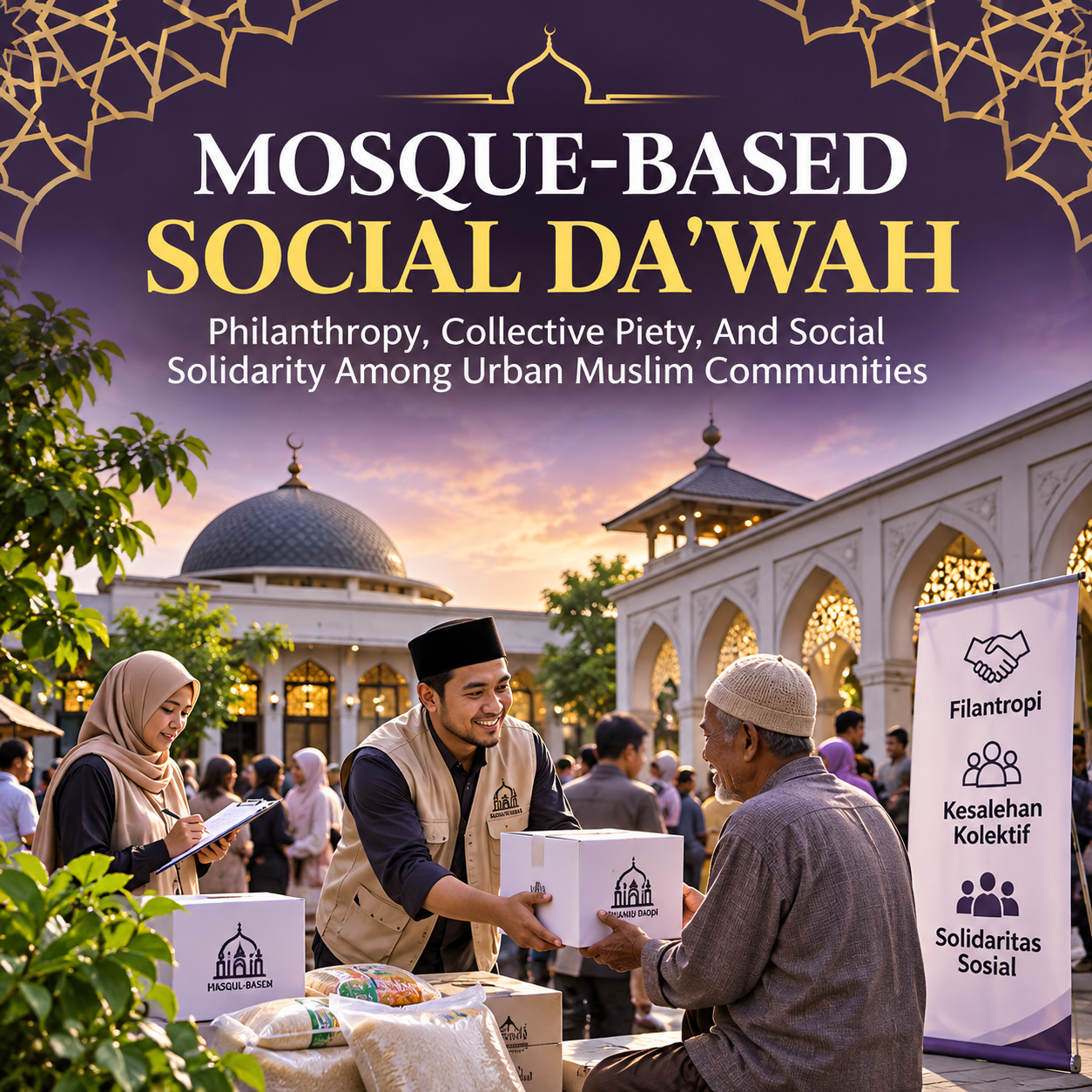
MOSQUE-BASED SOCIAL DA'WAH
Philanthropy, Collective Piety, And Social Solidarity Among Urban Muslim Communities

Downloads
How can mosque-based philanthropy function as a form of social da'wah that connects religious commitment with collective piety and social solidarity in urban Muslim communities? This article addresses the question through a conceptual approach based on a critical narrative review of scholarship on Islamic philanthropy, mosque-based welfare, religious communication, and social relations. Publicly available information on Masjid Syuhada, Yogyakarta, is used as an illustrative institutional context rather than as evidence from new fieldwork. The discussion shows that philanthropy becomes meaningful social da'wah when religious values are translated into accountable institutions, participatory practices, and inclusive responses to community needs. The article proposes a four-stage framework comprising religious communication, ethical resource mobilization, collective practice, and solidarity with social learning. It also identifies class exclusivity, donor-centred practices, and short-term charity as challenges requiring attention to justice, dignity, and accountability.
Bagaimana filantropi berbasis masjid dapat berfungsi sebagai bentuk dakwah sosial yang menghubungkan komitmen keagamaan, kesalehan kolektif, dan solidaritas sosial dalam masyarakat Muslim perkotaan? Artikel ini membahas pertanyaan tersebut melalui pendekatan konseptual dengan metode tinjauan naratif kritis terhadap literatur mengenai filantropi Islam, kesejahteraan berbasis masjid, komunikasi keagamaan, dan relasi sosial. Informasi publik mengenai Masjid Syuhada Yogyakarta digunakan sebagai konteks ilustratif kelembagaan, bukan sebagai bukti penelitian lapangan baru. Pembahasan menunjukkan bahwa filantropi menjadi dakwah sosial ketika nilai-nilai keagamaan diterjemahkan ke dalam kelembagaan yang akuntabel, praktik partisipatif, dan respons inklusif terhadap kebutuhan masyarakat. Artikel ini mengusulkan kerangka empat tahap yang meliputi komunikasi keagamaan, mobilisasi sumber daya secara etis, praktik kolektif, serta solidaritas dan pembelajaran sosial. Artikel ini juga mengidentifikasi eksklusivitas kelas, praktik yang berpusat pada donor, dan bantuan jangka pendek sebagai tantangan yang memerlukan perhatian terhadap keadilan, martabat, dan akuntabilitas.
Abidin, Zaenal, Azlinda Azman, and Paramjit Singh Jamir Singh. “Beyond Charity: Study on Islamic Philanthropy Governance and the Implementation of Zakat Law.” Jurnal Ilmiah Hukum LEGALITY 34, no. 1 (March 29, 2026): 229–53. https://doi.org/10.22219/ljih.v34i1.43623.
Abrori, Abrori, and Ahmad Kharis. “DAKWAH TRANSFORMATIF MELALUI FILANTROPI: FILANTROPI ISLAM DALAM MENGENTAS KEMISKINAN DAN KETIDAKADILAN.” Jurnal Al-Ijtimaiyyah 8, no. 1 (June 30, 2022): 102. https://doi.org/10.22373/al-ijtimaiyyah.v8i1.13009.
A’isyah, A’isyah, and Zulkipli Lessy. “Investigating the Method of Da’wah and the Role of Political-Economy of Jemaah Tarbiyah in Urban Malang Society.” Wawasan Jurnal Ilmiah Agama Dan Sosial Budaya 7, no. 1 (November 12, 2022): 27–42. https://doi.org/10.15575/jw.v7i1.14591.
Akhter, Naseem, Syed Hamid Farooq Bukhari, Shakir Hussain, Shumaila Rafiq, and Arshad Munir. “Islamic Teachings as a Foundation for Social Equality and Justice in the Twenty-First Century.” In Sustainable Development, 2026. https://doi.org/10.5772/intechopen.1013757.
Arifin, Moh., Ridan Muhtadi, and Tate Agape Bawana. “Mosque Management Revitalization Through Economic Empowerment of Ummah.” International Journal of Islamic Thought and Humanities 3, no. 1 (March 23, 2024): 70–80. https://doi.org/10.54298/ijith.v3i1.96.
Asmaria, Asmaria, Heni Noviarita, Ali Abdul Wakhid, and Rini Setiawati. “Transforming Islamic Religious Counselors into Agents of Mosque-Based Community Economic Empowerment in Pesawaran Regency.” Journal of Islamic Economics Lariba 12, no. 1 (November 30, 2025): 167–98. https://doi.org/10.20885/jielariba.vol12.iss1.art6.
Bustami, Bustami, Hariya Toni, Muhammad Hisyam Syafii, and Husain Azhari. “Islamic Philanthropy and Muzakki Trust: Mediation of Sustainable Economic Empowerment in Sungai Penuh.” Review of Islamic Social Finance and Entrepreneurship, April 6, 2026, 100–119. https://doi.org/10.20885/risfe.vol5.iss1.art6.
Dalmeri, Dalmeri. “REVITALISASI FUNGSI MASJID SEBAGAI PUSAT EKONOMI DAN DAKWAH MULTIKULTURAL.” Walisongo Jurnal Penelitian Sosial Keagamaan 22, no. 2 (December 15, 2014): 321–50. https://doi.org/10.21580/ws.22.2.269.
Emzaed, Ali Murtadho, Sadiani Syarifuddin, Muhammad Lutfi Hakim, and Bukhari Ibrahim. “Shifting Fiqh Tradition in Zakat Management: Nahdlatul Ulama’s Strategies to Enhance the Social Welfare of Nahdliyin.” Al-Risalah Forum Kajian Hukum Dan Sosial Kemasyarakatan 24, no. 2 (December 30, 2024): 124–41. https://doi.org/10.30631/alrisalah.v24i2.1677.
Febriansyah, Febriansyah, Reny Handayani, Yusuf Rahman, and Maswani Maswani. “Digital-Based Zakat Management from a Good Governance Perspective at BAZNAS Muara Enim.” Review of Islamic Social Finance and Entrepreneurship, April 6, 2026, 174–87. https://doi.org/10.20885/risfe.vol5.iss1.art10.
Fuller, C. J., Marcel Mauss, and W. D. Halls. “The Gift: The Form and Reason for Exchange in Archaic Societies.” Man 27, no. 2 (June 1, 1992): 431. https://doi.org/10.2307/2804090.
Hamid, Abdul, Badrah Uyuni, Sarbini Anim, Muhammad Muneeb Ahmad, Muslimin Muslimin, and Sofia Fahrany. “Strengthening the Strategic Role of Mosques in Jakarta: From Spiritual Preaching to Economic Empowerment.” Madinah Jurnal Studi Islam 12, no. 1 (May 27, 2025): 130–46. https://doi.org/10.58518/madinah.v12i1.3495.
Haz, Abdul Hamzah, Bahri Ghazali, Hasan Mukmin, Rini Setawati, and M. Mawardi J. “Mosque-Based Community Empowerment to Improve Welfare in Pringsewu Regency, Lampung Province.” International Journal of Academic Research in Business and Social Sciences 15, no. 12 (December 25, 2025). https://doi.org/10.6007/ijarbss/v15-i12/27351.
Hidayat, Kholid, Faisal Santiago, Mohammad Fahmy, Rifqi Ardae, and Sopyan Lubis. “Zero Cash Balance and Trust Building in Mosque Philanthropy: Optimizing Zakāh and Waqf for Community Empowerment at Jogokariyan Mosque.” JURNAL INDO-ISLAMIKA 15, no. 2 (December 26, 2025): 433–46. https://doi.org/10.15408/jii.v15i2.48755.
Huda, Fatkur, M. Febriyanto Firman Wijaya, Erdin Nadid, Salma Nadia Salsabilla, and Salman Farisi. “THE ROLE OF MOSQUES IN UTILIZING ZAKAT, INFAQ, AND SHADAQOH AS SUSTAINABLE SHARIA FINANCIAL INSTRUMENTS IN SURABAYA.” Ekonomi Islam 16, no. 1 (May 31, 2025): 167–81. https://doi.org/10.22236/jei.v16i1.16162.
Imari, Iqbal, and Muh. Syahru Ramadhan. “Establishing Economic Empowerment System Through Mosque Based Community.” Jurnal Ilmu Ekonomi Dan Bisnis Islam 7, no. 1 (June 30, 2025): 1–17. https://doi.org/10.24239/jiebi.v7i1.348.1-17.
Irham, Muhammad. “Filantropi Islam Dan Aktivitas Sosial Berbasis Masjid Di Masjid Al-Hidayah Purwosari Yogyakarta.” SANGKéP Jurnal Kajian Sosial Keagamaan 2, no. 1 (July 17, 2019): 69–90. https://doi.org/10.20414/sangkep.v2i1.482.
Kailani, Najib, and Martin Sláma. “Accelerating Islamic Charities in Indonesia:Zakat,Sedekahand the Immediacy of Social Media.” South East Asia Research 28, no. 1 (December 4, 2019): 70–86. https://doi.org/10.1080/0967828x.2019.1691939.
Kamaruddin, Siti, Salbiah Mokhtar, Kamariah Abdullah, Norainah Abdul Rahman, Arina Rahmat, and Azila Ahmad Sarkawi. “A Comprehensive Literature Review on the Role of Masjid (Mosque) as an Important Development Hub.” Built Environment Journal 23, no. 2 (July 3, 2026). https://doi.org/10.24191/bej.v23i2.5858.
Khoirunnisa, Tsabita Afifah, Amanah Nurish, and Sapto Priyanto. “Sharia Principles in Counternarratives of Charity-Based Terrorism Financing.” Review of Islamic Social Finance and Entrepreneurship, March 31, 2026, 46–64. https://doi.org/10.20885/risfe.vol5.iss1.art3.
Kholis, Nur. “CoreTax-Based Zakat and Tax Integration: Synergizing Islamic Public Finance and National Fiscal Governance in Indonesia.” Journal of Islamic Economics Lariba 12, no. 1 (March 29, 2026): 907–40. https://doi.org/10.20885/jielariba.vol12.iss1.art32.
Kurniawati, Neneng Nadila, Afief El Ashfahany, and Muhammad Sajid Khan. “The Mosque as an Agent of Social Welfare: Philanthopic Programs at Jogokariyan Mosque.” Suhuf 37, no. 2 (November 14, 2025): 263–73. https://doi.org/10.23917/suhuf.v37i2.10798.
Latief, Hilman. “Philanthropy and ‘Muslim Citizenship’ in Post-Suharto Indonesia.” Southeast Asian Studies 5, no. 2 (January 1, 2016): 269–86. https://doi.org/10.20495/seas.5.2_269.
Ma’arif, Muhammad Anas, Muhamad Arif, Mauhibur Rokhman, Ali Usman Hali, Ari Kartiko, and Akhmad Sirojuddin. “Model of Kiai Leadership Based on Local Wisdom: Preventing Radicalism and Building Education in the Global South.” Kharisma Jurnal Administrasi Dan Manajemen Pendidikan 5, no. 1 (March 12, 2026). https://doi.org/10.59373/kharisma.v5i1.149.
Maghfirah, Maghfirah, Irma Romi Anto, Ahmad Maulidizen, Muhammad Alpi Syahrin, and Alfiandri Setiawan. “Zakat, Technology, and Trust.” SAMARAH Jurnal Hukum Keluarga Dan Hukum Islam 10, no. 2 (July 31, 2026): 1289–1322. https://doi.org/10.22373/fj4a8z24.
Makhrus, Makhrus, and A. Sulaeman. “Centralized Management of Islamic Philanthropy at LAZISMU Banyumas: Enhancing Welfare through Community-Based Innovation in Indonesia.” Journal of Islamic Economics Lariba 11, no. 1 (June 30, 2025): 573–96. https://doi.org/10.20885/jielariba.vol11.iss1.art22.
Masuwd, Mowafg. “Revitalizing the Mosque’s Role as an Economic Stabilizer for the Muslim Community: Social Fiqh Perspectives and Contemporary Practice.” Al Qalam Jurnal Ilmiah Keagamaan Dan Kemasyarakatan 20, no. 1 (January 13, 2026): 291. https://doi.org/10.35931/aq.v20i1.5913.
Muhammadi, A. Muwahid, Muammar Zulfiqri, and Muhammad Aunurrochim Mas’ad Saleh. “TRANSFORMATION OF ISLAMIC DA’WAH IN THE DIGITAL ERA AND ITS INFLUENCE ON THE RELIGIOUS LITERACY OF MUSLIM MILLENNIALS.” KARIMIYAH Journal of Islamic Literature and Muslim Society 6, no. 1 (June 23, 2026): 1–14. https://doi.org/10.59623/07fvxy33.
Nadhif, Moh., Akhmad Sirojuddin, Ali Wafa, Muhammad Najib, and Salman Khalid bin Othman. “Reconceptualizing Pesantren as Living Educational Ecosystems through Gus Mus’ Humanistic Pedagogy.” Journal of Pesantren and Diniyah Studies 3, no. 1 (June 25, 2026): 33–50. https://doi.org/10.63245/jpds.v3i1.62.
Nasution, Mhd. Indra Mulia, Mustapa Khamal Rokan, and Muhammad Habibi Siregar. “Revitalizing Mosque Management: A Social and Cultural Framework for Boosting Local Economic Growth.” Jurnal Ilmiah Manajemen Kesatuan 13, no. 5 (October 3, 2025): 4037–50. https://doi.org/10.37641/jimkes.v13i5.4007.
Nasution, Prayudi Ibrahim, Wida Reza Hardiyanti, Novat Pugo Sambodo, and Eka Armas Pailis. “Does Effective Governance Matter for Islamic Social Finance? Evidence from Mosques in Yogyakarta.” Jurnal Ekonomi & Keuangan Islam, January 22, 2026, 1–21. https://doi.org/10.20885/jeki.vol12.iss1.art1.
Prabandari, Atin. “Beyond the Western Gaze: Islamic Humanitarianism and the Decolonization of Global Aid.” QIJIS (Qudus International Journal of Islamic Studies), August 10, 2026. https://doi.org/10.21043/qijis.v14i1.32221.
Puspito, Toto Andri, Zezen Zainul Ali, Ali Akram Kadhim, Essa Lafi Hassan Al Smadi, and Hamdan Ghunemat. “Evaluating Digital Zakat Platforms: Usability, Technical Performance, and Maṣlaḥah in Indonesia and Malaysia.” Nusantara Journal of Law Studies 5, no. 1 (June 7, 2026): 631–70. https://doi.org/10.66325/nusantaralaw.v5i1.261.
Rachmayanti, Amalia Cahya. “Social Piety Through Community Social-Economic Empowerment At Nurul Ashri Mosque Yogyakarta.” International Journal of Sociology of Religion. 2, no. 2 (January 17, 2025): 538–49. https://doi.org/10.70687/4408qr63.
Rasiam, Rasiam, Umiyati Umiyati, Habibullah Habibullah, Dimas Kenn Syahrir, and Muhammad Said. “Integration of New Media and Prophetic Communiacation Enhanced for Zakah, Infāq, Ṣadaqah, and Waqf Fundraising: A Case Study of Baitulmaal Munzalan Indonesia.” Journal of Islamic Law 4, no. 1 (February 15, 2023): 28–46. https://doi.org/10.24260/jil.v4i1.1167.
Salwa, Nisrina. “Digital Da’wah in the Age of Algorithm: A Narrative Review of Communication, Moderation, and Inclusion.” Sinergi International Journal of Islamic Studies 2, no. 4 (November 30, 2024): 242–56. https://doi.org/10.61194/ijis.v2i4.706.
Setiawan, Nanang, and Muhammad Nizarul Alim. “Islamic Philanthropy as a Deterrent to Potential Fraud.” Share Jurnal Ekonomi Dan Keuangan Islam 11, no. 1 (June 30, 2022): 129–48. https://doi.org/10.22373/share.v11i1.11074.
Shalihin, Nurus, Firdaus Firdaus, Yulia Yulia, and Ujang Wardi. “Ramadan and Strengthening of the Social Capital of Indonesian Muslim Communities.” HTS Teologiese Studies / Theological Studies 76, no. 3 (December 21, 2020). https://doi.org/10.4102/hts.v76i3.6241.
Shulthoni, Muhammad, Yuli Utami, and Hendri Hermawan Adinugraha. “Islamic Philanthropy as Theological Practice: A Qualitative Study of Zakat and Waqf in Indonesia.” Pharos Journal of Theology 107, no. 3 (June 15, 2026). https://doi.org/10.46222/pharosjot.107.3012.
Syaikhu, Syaikhu, Norwili Norwili, Maimunah Maimunah, and Laili Wahyunita. “The Empowerment of Infaq and Waqf Evaluation in Light of Maqasid Al-Sharia Perspective in Mosques in Palangka Raya, Indonesia.” SAMARAH Jurnal Hukum Keluarga Dan Hukum Islam 5, no. 2 (December 25, 2021): 1003. https://doi.org/10.22373/sjhk.v5i2.8997.
Syuhada, Erwin Febrian, and Shulton Fathoni. “Community Needs and Assets Mapping in Islamic Education: Strengthening Stakeholder Collaboration for Community Empowerment and Social Transformation.” Al Ghazali. 6, no. 6 (September 24, 2026): 2289–2317. https://doi.org/10.69900/ag.v6i6.720.
Tike, Arifuddin, Kamaluddin Tajibu, and Akhmad Fathur Fahlevi. “Empowerment the An-Nadzir Community in South Sulawesi.” SAMARAH Jurnal Hukum Keluarga Dan Hukum Islam 10, no. 2 (June 16, 2026): 831–59. https://doi.org/10.22373/sjhk.v10.i2.33769.
Zara, Muhammad Yuanda. “Syuhada Mosque and Its Community in Changing Yogyakarta, 1950s�1980s.” Journal of Indonesian Social Sciences and Humanities 6, no. 2 (December 5, 2018): 13–28. https://doi.org/10.14203/jissh.v6i2.37.
Copyright (c) 2026 suryanti

This work is licensed under a Creative Commons Attribution-NonCommercial 4.0 International License.
Authors who publish with this journal agree to the following terms:
- Authors retain copyright and grant the journal right of first publication with the work simultaneously licensed under a Creative Commons Attribution License that allows others to share the work with an acknowledgement of the work's authorship and initial publication in this journal.
- Authors are able to enter into separate, additional contractual arrangements for the non-exclusive distribution of the journal's published version of the work (e.g., post it to an institutional repository or publish it in a book), with an acknowledgement of its initial publication in this journal.
- Authors are permitted and encouraged to post their work online (e.g., in institutional repositories or on their website) prior to and during the submission process, as it can lead to productive exchanges, as well as earlier and greater citation of published work (See The Effect of Open Access).