Book Review Template
Book Review Template
The Title of the Book Review, all in Bold, Italic, Capitalized Each Word, and Centered
The author’s name and the affiliation must not be written here, just put them in the “user profile” in the journal website. It is suggested as well to remove all “document properties and personal information” from your file.
Extract (Book reviews must include an extract, not a research article-style abstract, providing a concise overview and critical assessment of the reviewed book.)
The extract must be written exclusively in English and should briefly introduce the reviewed book, including its title, author, and central arguments. Highlight the book’s key theoretical perspectives and contributions to sociological scholarship. Critically assess its strengths and limitations rather than merely summarizing its contents. Explain its relevance to contemporary social phenomena, particularly within the sociology of religion or related sociological fields. Conclude by emphasizing the book’s significance for advancing sociological understanding and theoretical debates. The extract must not exceed 200 words.
[There are no keywords for Book Review]
Background
Your text is here, in 12pt font-size, 1.5 line-spacing; don’t add space before and/or after paragraph. It is much better to not format your text in a specific technique, instead, just leave it plain except that you really need to type certain words in a “special method”, or to emphasize certain word or words. Italic is a must in typing non-English word.
The background section should introduce the reviewed book by providing relevant information about its author, publication context, and the broader academic debates in which the book is situated. Explain the key sociological issues addressed in the book and their significance for contemporary sociological scholarship, particularly within the sociology of religion or related fields. Discuss why the book is important and relevant to current theoretical debates or social phenomena. Clearly establish the rationale for reviewing the book, identify its potential contributions to sociological understanding, and outline the main analytical focus of the review. Avoid lengthy descriptions of the book’s contents, as this section should establish the context and critical direction of the review rather than provide a chapter-by-chapter summary.
Flexible Subheadings
Authors may organize this section into several subheadings according to the main themes, theoretical arguments, or critical issues addressed in the reviewed book. Subheadings are flexible and may focus on the book’s key arguments, theoretical contributions, methodological approaches, strengths, limitations, or relevance to contemporary sociological phenomena. The discussion should move beyond descriptive summaries and critically engage with the author's arguments, analytical consistency, and supporting evidence. Particular attention should be given to the book’s contributions to sociological scholarship, especially within the sociology of religion or related fields. Authors are encouraged to develop their own critical perspectives and support their evaluations with relevant academic literature.
Conclusion
The conclusion should provide a concise overall assessment of the reviewed book, highlighting its major contributions, strengths, and limitations. Explain its significance for sociological scholarship and its relevance to contemporary theoretical debates or social phenomena. Authors should clearly articulate the book’s scholarly value and identify potential directions for further research or theoretical development. Avoid introducing new arguments or merely repeating the discussion.
References
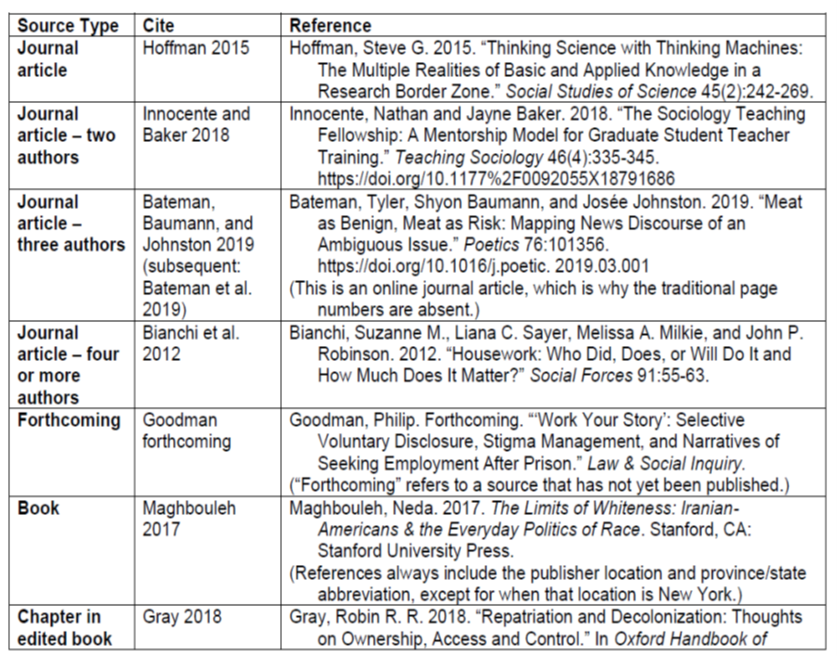
All reference mentioned should be written down in reference using The American Sociological Association 6th Edition style and arranged from A to Z. It should include references obtained from primary sources (consisting of scientific journals amounting to 80% of the entire references) that have been published in the last 10 (ten) years. Citation and reference systems must use the Reference Management System such as Mendeley, EndNote, Zotero.
How you write each reference in this section is based on its source type, as prescribed on the Sixth ASA Guides below: